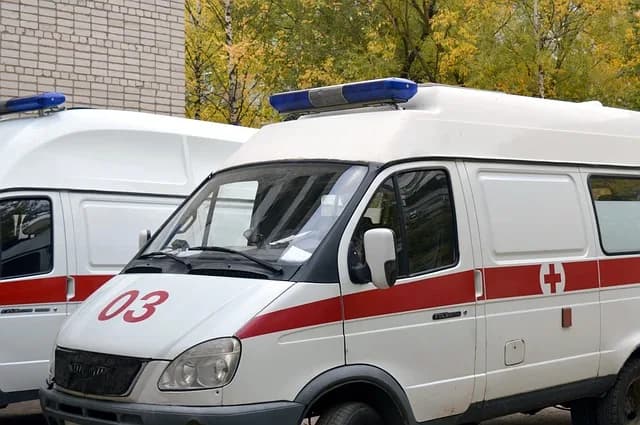
The types of ambulance vehicles in Indonesia are quite varied. This is because ambulances play a very important role in handling patients who need urgent care. In addition, each crew member and driver has been given a solid grounding in medical knowledge.
That way, they can respond quickly and give help to someone in line with proper procedures. But did you know that the types of ambulance vehicles are quite varied and each has different functions? This article covers them in full for you.
What Is an Ambulance?
Actually, the word ambulance comes from the Latin word ambulare. That word means to move or to walk. Based on its function, the name really suits this vehicle.
In the past, these vehicles were used to carry fighters who had been wounded in war. Ambulances also carried medical staff heading to the battlefield. Over time, the function of ambulances changed.
In other countries, ambulances are not only vehicles but can also take the form of helicopters. Besides that, these vehicles have sirens and red and blue lights. Usually the driver turns on the siren and lights when needing to get through traffic jams, so they can reach the destination as quickly as possible.
As a road user, it is very important to give priority to an ambulance and let it pass ahead of you. In fact, there are rules that give these vehicles priority on the road, so other road users must make way for them.
An ambulance is also permitted to break traffic rules. That means that at a red light, the vehicle may still proceed through the junction. In fact, an ambulance may take the opposite lane if it is necessary because the road is congested.
4 Types of Ambulance Vehicles and Their Functions
Here are the 4 types of ambulance vehicles, along with their functions, that you should know:
1. Emergency Ambulance
As the name suggests, an emergency ambulance is used to transport patients in critical condition. These vehicles are commonly used for victims of traffic accidents with serious injuries. In addition, emergency ambulance services can be accessed free of charge.
These ambulances are divided into two types: general emergency vehicles and specialized emergency vehicles. The difference between the two lies in the medical equipment they carry.
Vehicle ambulance for emergencies must have 2 trained personnel. In addition, this vehicle emergency or advance is equipped with several medical tools, such as a monitor, ventilator, oxygen, IV drip, and piggyback. Its medical equipment is indeed more complete than that of other ambulance vehicles.
2. Transport Ambulance
The second type is the transport ambulance. This vehicle serves to carry patients who need treatment. This type of ambulance can come in the form of an ordinary car, a van, or even a motorbike.
This vehicle is intended for patients who do not require special care or particular emergency measures. Inside, you will find oxygen, simple medicines, a blood pressure monitor, and a sufficient amount of IV fluid.
3. Field Hospital Ambulance
Besides the two above, there is also the third type, the ambulance field hospital. This type of ambulance is generally used for everyday hospital activities or non-critical conditions.
When needed, it is usually combined with a mobile medical service vehicle or similar ambulance units.
4. Hearse
As its name suggests, the hearse is a vehicle that carries the deceased. It has a simple design and takes the deceased to their destination.
Unlike some other types of ambulance, a hearse has no medical equipment. In other words, its interior is also more open. You will only find seats and a casket stretcher.
2 Vehicles Suitable for Use as an Ambulance
Today there are many vehicles you can use as an ambulance. Especially for the transport type of ambulance. Here are 2 vehicles suitable for use as ambulances:
1. Luxio
Minibuses are made for passenger transport. It is therefore common to see them used for public transportation, including as an ambulance.
There are several Luxio models: D, X, and M. The models suitable as an ambulance are the Luxio X and M. These variants have a row of seats that you can slide.
2. Gran Max MB
Another option is the Gran Max MB, which can also be used as an ambulance. This vehicle has a spacious interior, so it is well suited to accommodate patients. Besides serving as an ambulance, the Gran Max MB is also suitable as a hearse.
There are two types of this vehicle: blind van and passenger car. For an ambulance, it is best to choose the second type, the passenger car..
This is because the rear section can be detached easily. In addition, its seating position can be adjusted, either facing forward or facing each other. This makes it more flexible when transporting patients or the deceased.
Now That You Know More About Types of Ambulance Vehicles?
That concludes our overview of the 4 types of ambulance vehicles, along with their functions and which vehicles are suitable for ambulance use. In an emergency, such as when a close family member has passed away, an ambulance is truly essential. You cannot rely on ambulance facilities from hospitals or community health centers alone, as their numbers are limited.
For this reason, you may consider using a funeral ambulance service so the deceased can receive proper care right away without any delay. You can also make use of a trusted funeral service that will handle all funeral arrangements in full, such as Kamboja. Kamboja also provides professional funeral protection for you and your family when the time comes. This way, the deceased can receive the most dignified treatment.

dev_kamboja
The Kamboja team writes guides on bereavement, funeral arrangements and funeral planning to help families in Indonesia.