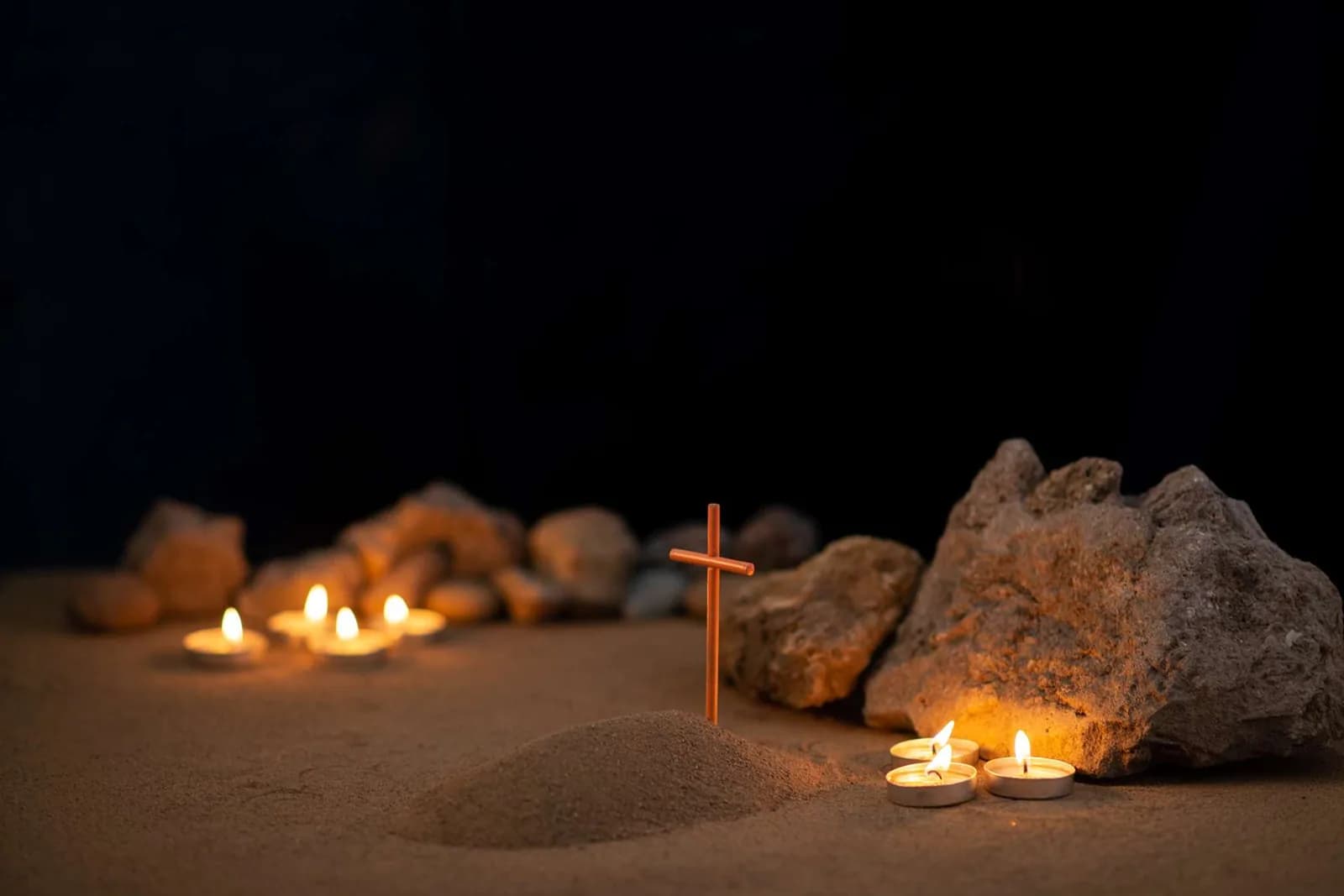
Have you ever heard of, or even experienced, a funeral held at night? In some regions this is still a matter of debate. Some say it is permissible, while others feel it is better avoided.
Usually this question arises for various reasons, ranging from religious and traditional factors to practical considerations such as timing and particular circumstances.
So, is a nighttime funeral allowed or not? Are there specific rules in religion, particularly Islam, that govern this? In this article we will discuss in a complete and relaxed way the ruling on nighttime funerals, the reasons behind whether they are permitted, and the things to consider before holding one. Let's take a look!
The Ruling on Nighttime Burial in Islam
What is the actual ruling on nighttime burial in Islamic funerals? As it turns out, scholars hold several different opinions, but all of them are grounded in textual evidence and considerations of the Shariah. To make it easier to understand, let us go through them one by one:
1. The View of Some Scholars
Some scholars, such as Sa'id bin Musayyib, hold that burial at night is makruh (discouraged). This means it is not forbidden, but it is better avoided if there is no pressing reason.
According to this view, a nighttime burial may be carried out only in emergency conditions, for example when the body must be buried immediately or when particular circumstances make it impossible to wait until daytime. This opinion is mentioned in the book Al-Muhalla (5: 114).
The reasoning behind this view usually relates to the limitations of nighttime, such as poor lighting (especially in earlier times), fewer people present to perform the funeral prayer over the body, and concern that the preparation of the body may not be carried out to its fullest.
So, it is not strictly prohibited, but rather a recommendation to choose a more ideal time where possible.
2. The View of the Majority (Jumhur) of Scholars
In contrast to the previous view, the majority of scholars (jumhur) state that nighttime burial is permissible and not makruh. This means there is no problem at all, as long as the process is carried out properly and in accordance with the Shariah.
This view is based on a hadith from Ibn 'Abbas radhiyallahu 'anhuma, which relates that the Prophet shallallahu 'alaihi wa sallam once performed the funeral prayer over a person who had already been buried at night (HR. Bukhari no. 1340).
In that hadith, the Prophet did not object to the practice of nighttime burial. Indeed, in a narration in Muslim (no. 956), the Prophet only said, "Why did you not inform me?".
This shows that what was regretted was not the timing of the burial, but the fact that he had not been informed.
This serves as strong evidence that nighttime burial is not prohibited in Islam, because if it were forbidden, the Prophet would surely have rebuked the companions directly.
3. The Practice of the Companions
Aside from the hadith, the permissibility of nighttime burial is also reinforced by the practice of the companions. One example is the burial of Abu Bakr Ash-Shiddiq radhiyallahu 'anhu, which was carried out before morning (HR. Bukhari no. 1387).
This shows that the companions themselves did not object to burial at night.
Moreover, Ibn Hajar Al-Asqalani rahimahullah noted that this is akin to an ijma' (consensus) among the companions that nighttime burial is permitted (Fathul Baari, 3: 208).
In other words, this practice was widely known since the era of the companions, and there was no objection from them. This reinforces the principle that the original ruling is permissibility.
4. Hadith That Appear to Prohibit It
There are indeed hadith that mention a prohibition on burying the deceased at night, such as the narration in Ibn Majah (no. 1521). However, this hadith is judged weak because one of the narrators in its chain is not considered reliable, so it cannot be used as a basis for ruling.
Meanwhile, in a narration in Muslim (no. 943), there is a hadith mentioning a prohibition on burying the deceased at night except under compelling circumstances. Yet scholars explain that this prohibition is not an absolute one, but rather due to specific reasons.
For instance, if the burial takes place during the day, more people are usually able to attend and perform the funeral prayer. In addition, there were cases where the body was not shrouded properly, and the Prophet disliked such conditions.
Thus, this prohibition is more about preserving the quality of the funeral preparation, not merely because of the time being night.
Can a Funeral Be Held at Night?
In Islam, nighttime burial is not forbidden. In fact, from the various explanations of scholars and the existing hadith, we can understand that this has been practiced since the time of the Prophet and his companions.
So, it is not something strange or deviant. However, there are several important points to understand so that no misconceptions arise.
First, the original ruling is indeed permissibility. The majority of scholars (jumhur) agree that burial at night is not makruh and remains valid as long as all the procedures are carried out correctly and in accordance with the Shariah.
Second, permissible does not always mean better. Under normal conditions (when there is no urgency), some scholars recommend that burial be carried out during the day. The reason is simple: usually more people can attend to perform the funeral prayer and pay their final respects.
Furthermore, daytime conditions also better support the funeral process being carried out to its fullest.
Third, nighttime burial is strongly recommended if there is a need or particular circumstance. For example, to expedite the preparation of the body, to avoid things that could harm the condition of the body, or due to particular situations that make it impossible to carry out during the day.
Most importantly, whether by day or by night, the rights of the deceased must still be upheld. Do not let the fact that it takes place at night cause the process to become rushed, undignified, or inconsistent with proper etiquette.
Still Unsure About Nighttime Funerals?
Nighttime burial is fundamentally permitted in Islam, as long as there are no violations of the Shariah, such as a process that is rushed, incomplete, or lacking in respect for the deceased.
However, if there is no pressing condition, some scholars do recommend that burial be carried out during the day so that the process is more complete and more people can take part in paying their final respects.
In a time of grief, the last thing a family needs is the burden of managing the technical details of a funeral. That is why Kamboja provides a complete and trusted Islamic funeral service, from preparation through to the final stages. All needs are handled professionally in accordance with Islamic funeral procedures, so families need not worry about getting the correct steps.
Our experienced team also ensures that every stage of how to bury a body is carried out with full respect and in accordance with the Shariah.
If you need help or would like more information about our funeral services, please do not hesitate to contact the Kamboja team at 0822-1111-1415.
The professional Kamboja team is ready to support you and your family with empathy, from administrative arrangements through to the entire funeral procession, so that you can feel more at ease during this difficult time.
- #funeral services

Kamboja Blog
The Kamboja team writes guides on bereavement, funeral arrangements and funeral planning to help families in Indonesia.


