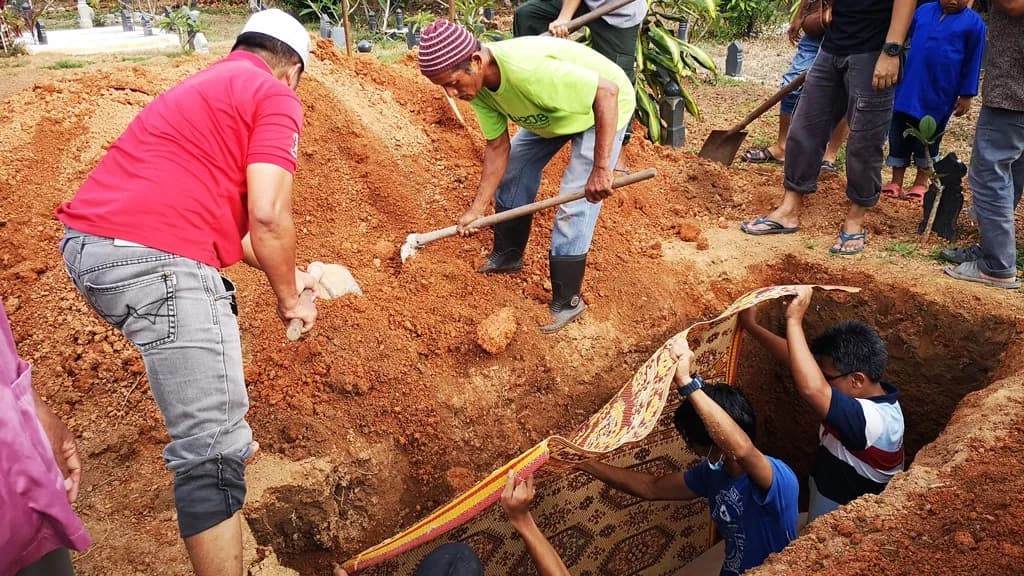
Every living being will certainly experience death, as it is destined. In Islam, a person who has passed away must be buried in the ground. The burial of the deceased in the Islamic faith has its own procedures that must be understood correctly.
The ruling on burying the deceased in Islam is fardhu kifayah, meaning that someone must carry it out. If no one does, then everyone in that area will bear the sin.
Below is a complete explanation of the procedures for burying the deceased in Islam.
Burial Procedures for the Deceased in Islam
Burial in Islam cannot be done carelessly. There are procedures and requirements that must be followed. It is not acceptable to place the body in the ground and cover it without any proper process, because Islam is a religion of good manners and dignity.
Furthermore, burial also means accompanying the deceased for the last time before they stand before Allah SWT, the owner of their soul and body. For this reason, there are also specific prayers that should be recited when burying the deceased.
Islam greatly honors human beings, even after they have died. This is in line with the words of Allah SWT in QS Al Isra verse 70, which reads:
وَلَقَدْ كَرَمْنَا بَنِي آدَمَ
Meaning: “And indeed, We have honored the children of Adam.” (QS Al Isra: 70)
The following are the burial procedures in accordance with Islamic law.
-
Minimum Obligations
The minimum obligation in burying the deceased is to place the body in a grave deep enough that its smell does not spread and animals cannot sniff out and prey on the corpse.
In addition, the body being buried must face the qibla. This minimum obligation may be applied especially in urgent circumstances or situations where it is not possible to bury the deceased in the more complete manner.
Some of the urgent circumstances referred to include mass burials of victims of natural disasters, deaths from diseases that could spread to others, and so on.
-
Requirements for the Lahd (Niche Grave)
As explained earlier, the grave pit used to bury the deceased must not invite wild animals to eat the corpse. For this reason, the grave should also not be too shallow, as this may allow the smell to spread.
The ideal depth of a lahd is about the height of a standing person with arms raised upward, and a width of roughly one hand span or one dhira’. In fact, a hadith mentions that the grave should be made spacious and well made.
If the burial is not taking place in a public cemetery (TPU) or public burial ground (TPS), the chosen location should be one that is not prone to hazards such as landslides and the like.
-
Placing the Body on Its Right Side Facing the Qibla
The next procedure for burying the deceased in Islam is to lay the body on its right side, facing the qibla, after it has been placed in the lahd. For this reason, digging the grave cannot be done carelessly.
In Indonesia, the qibla generally faces west, so the grave should be dug lengthwise from south to north. Thus, for the body to face the qibla, the head should be placed to the north and the feet to the south.
It is also recommended (sunnah) to press the cheek of the deceased against the ground. If, after burial, it is discovered that the body was not faced toward the qibla, it is obligatory to dig it up again and turn it toward the qibla.
-
Recommended Grave Design Based on Soil Texture
Making a lahd is recommended if the soil is firm. A lahd is a niche cut into the wall of the grave on the qibla side, large enough to accommodate the body when it is placed inside.
After the body has been placed in the lahd, it is covered with flat stones so that the body is not struck by falling soil when the grave is filled. However, it is recommended to create a kind of recess at the very bottom of the grave if the soil is loose.
The recess should be roughly large enough to lay the body in, and then brick-like structures or similar materials should be built along both sides.
The body is then placed in this recess, and before the grave is filled, it is first covered with flat stones so that it is protected from falling soil. However, in Indonesia, wooden boards or bamboo are more commonly used to shield the body from falling soil during filling.
-
Untying the Shroud Ties
When placing the body into the lahd, it should be done gently while reciting:
بِسْمِ اللهِ وَ عَلَى سُنَّةِ رَسُولِ اللهُ صَلَّى اللهُ عَلَيْهِ وَ سَلَّمَ
“Bismillahi wa ‘ala sunnati Rasulillahi shallallahu ‘alaihi wa sallam.”
It is preferable that the person who places the body into the lahd be the closest male relative who loved the deceased most during their lifetime. Once the body is laid down, it is recommended to untie the ties of the burial shroud, starting from the head.
According to Shaykh Nawawi Al Bantani in the book Kasyifatus Saja, it is recommended to cover the grave opening with cloth or something similar when the body is buried. The purpose is so that if anything becomes exposed from the body, it can be covered.
-
Reciting the Adhan
After the shroud ties have been released, the burial procedures in Islam mention that there is a recommendation to recite the adhan for the deceased. This is recommended in the teachings of the Shafi‘i school of thought.
Scholars who follow this school liken the adhan for the deceased to the adhan recited for a newborn entering the world. The adhan is performed before the body is covered with soil, with the muadhdhin still inside the grave while reciting it.
-
Reciting the Talqin
After the body has been covered with soil, those attending the burial are recommended to sit. It is then encouraged for the talqin to be recited to the deceased, which may be done by the religious leader present.
The talqin is a recitation intended as guidance or instruction for the buried deceased regarding the questioning in the grave and so on. This is recommended in line with the saying of the Messenger of Allah SAW that a person who is dying should be taught the declaration of faith (tawhid).
Those who have stood before Allah SWT will be questioned in the grave, so talqin is needed as guidance, much like asking a passerby for directions on the road.
-
Praying for Forgiveness for the Deceased
Beyond the talqin, once the deceased has been buried, a prayer asking for forgiveness for them is also recited. The deceased cannot pray for themselves, so those who accompany them should pray for their forgiveness.
Not only after the burial and talqin, the deceased also needs prayers so they may receive forgiveness from Allah SWT, since once they have returned to Him there is no longer an opportunity to ask for forgiveness.
There are quite a few procedures for burying the deceased in Islam, yet all of them are etiquette that should be honored, as they are commands and recommendations from Allah and His Messenger. For this reason, while we are still alive, it is strongly encouraged to learn these procedures.
Kamboja provides emotional support and stands by your side in providing professional funeral protection and funeral services when that day comes.

dev_kamboja
The Kamboja team writes guides on bereavement, funeral arrangements and funeral planning to help families in Indonesia.


