The Law and Explanation of the Custom of Scattering Flowers on Graves
- dev_kamboja
- (updated )
- 5 min read
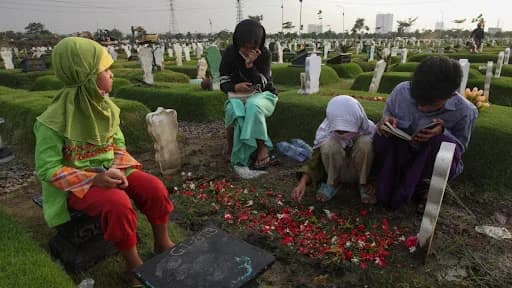
Grief is a painful experience, because we must lose the people we love. Beyond leaving deep sorrow, the impact of grief can also weigh on the bereaved psychologically, physically, and even financially. That is why, after the burial, many families scatter flowers on the grave.
Scattering flowers, or nyekar is usually done together with prayers for the departed, asking that they rest peacefully with God. So what is the ruling and explanation for the custom of nyekar at graves that so many people practice? Here is a fuller answer.
The Tradition of Scattering Flowers on Graves
The tradition of scattering flowers or visiting graves has become a common custom in the community, especially on Fridays or when Ramadan arrives. This practice aims to pray for the departed and to remind people of the grief that is certain to come.
The Messenger of Allah shallallahu ‘alaihi wa sallam permitted his followers to visit the graves of loved ones, ancestors, and scholars at any time, without a set time limit. The purpose is to remind them of grief.
From this, many people make pilgrimages to the graves of family members and religious scholars.
Indonesians use several terms for this tradition. The Javanese, for example, commonly call it nyekar. Nyekar is a term derived from the word “sekar” meaning flower.
Scattering flowers on a grave is also commonly done after the burial is complete. Once the body has been placed in the grave, facing the qibla, the shroud cord has been untied, the adhan has been recited, and the grave has been covered with soil, many people then scatter flowers, sprigs, or palm fronds over the departed's grave.
The flowers are usually sprinkled with water so they look fresh and do not wilt quickly, not for any mystical purpose. Commonly used flowers include jasmine, frangipani, red roses, cananga, ylang-ylang, white roses, tuberose, and gambir jasmine.
It can be said that scattering plant parts over graves has become a common tradition in this country.
Regarding placing plants on graves, this matches what the Messenger of Allah shallallahu ‘alaihi wa sallam did when he passed two graves where the occupants were being punished. He took a fresh, moist palm frond and planted it on the two graves.
Common Reasons for Scattering Flowers on Graves
The common reasons people hold regarding the tradition of scattering flowers on graves include:
1. Making the Grave Fragrant
Flowers or plants soaked in fragrant water produce a pleasant scent. This is indeed true, as flowering plants generally give off a pleasant aroma.
2. Making the Grave Look Beautiful
A grave looks more beautiful and well cared for when you regularly clean it and place flowers or other plants on it. A grave adorned with colorful flowers does look lovely.
In appearance, this can also be considered true, since the flowers commonly used come in many beautiful colors.
3. Considered a Sunnah?
Some hold that placing plants, kembang, or fragrances is a sunnah. Scattering fresh flowers is also believed to lighten the punishment the deceased experiences. This belief arises because the Messenger of Allah shallallahu ‘alaihi wa sallam once placed palm fronds on two graves.
So, does this practice become a sunnah? Unfortunately, that assumption is not correct.
The Messenger shallallahu ‘alaihi wa sallam did place date palm fronds on graves so that the punishment of the grave might be lightened. However, what eases the punishment of those in the grave is the blessing of prayer and intercession from the Prophet shallallahu ‘alaihi wa sallam, not the date palm fronds.
This is in line with the saying of the Messenger shallallahu ‘alaihi wa sallam which means:
“I passed by two graves whose occupants were being punished. I hoped that the punishment of both could be lightened through my intercession, for as long as the two halves of the palm fronds remained moist." (HR. Muslim: 3012).
The Law on the Tradition of Scattering Flowers or Nyekar
After reading the explanation of the tradition of nyekar , what is the ruling on performing nyekar at the grave of the departed? Does Islam permit or prohibit this tradition? Here is the explanation.
There is a narration that forms the basis for this tradition of nyekar . Shaykh Wahbah Az-Zuhayli, in the book Al-Fiqhul Islami wa Adillatuhu, relates that the Prophet once split a fresh branch and placed it on two graves whose occupants were undergoing the punishment of the grave.
Prophet Muhammad shallallahu ‘alaihi wa sallam did this solely to reduce the suffering the deceased were experiencing. However, this does not mean it is a recommendation for Muslims to do the same.
There are several reasons why the tradition of scattering flowers or other plant parts on graves is not an invitation from the Messenger shallallahu ‘alaihi wa sallam.
The first reason: the Messenger's shallallahu ‘alaihi wa sallam action was specific to a particular case and was one of his special privileges. This is because he did not do the same for other graves.
The second reason: there is no evidence that dried palm fronds or flowers stop glorifying their Creator. As Allah Ta'ala says in Surah Al-Isra' verse 44:
“The seven heavens, the earth, and everything in them glorify Allah. There is nothing that does not glorify Him with praise, but you do not understand their glorification. Indeed, He is Most Forbearing, Most Forgiving.”
In addition, Ibn 'Umar, in Fathul Baari 3/223, also said that the occupants of the grave are only shaded by their deeds during their life in this world, not by palm fronds.
In essence, the ruling on the practice of nyekar that people often perform is that it is not prescribed by the Islamic sharia. Moreover, this kind of practice was never commanded by the Messenger shallallahu ‘alaihi wa sallam or the companions.
Do You Know About the Tradition of Scattering Flowers and Its Ruling?
Having received the explanation of scattering flowers above, you now understand the ruling on nyekar within the Islamic religious law.
When it comes to burial, if you need funeral services on demand of good quality, use the services of Kamboja.
Kamboja will help take care of everything related to the impact of grief for a person, from the funeral process and managing guests or mourners, to administration, transportation of the body, through to compensation funds for the family. Kamboja also provides funeral protection for your loved ones when that day comes.
Most importantly, prepare yourself as well as you can, both in good deeds and in funeral arrangements, before death comes to take you.

dev_kamboja
The Kamboja team writes guides on bereavement, funeral arrangements and funeral planning to help families in Indonesia.