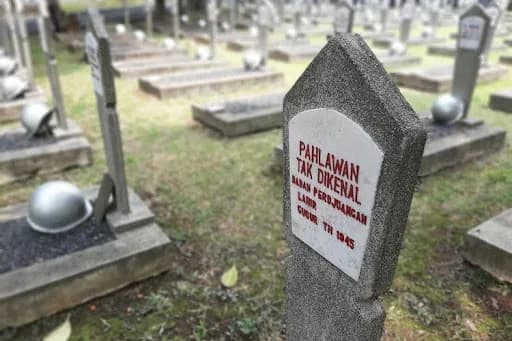
The Taman Makam Pahlawan (TMP), or Heroes' Cemetery, is certainly a familiar name to many people. Many visit a TMP at least once a year.
On National Heroes' Day, the government and the public usually hold various events to honor the heroes' contributions, from poetry reading events to pilgrimages to the final resting places of heroes located in several regions across Indonesia.
But do you know what a TMP is? If not, here is a full explanation along with its requirements and types!
What is a Taman Makam Pahlawan?
Taman Makam Pahlawan (TMP) is a burial site for heroes and freedom fighters who meet certain requirements to be interred there, and it serves as a expression of respect and appreciation for the heroes' contributions.
Not only heroes, but also people who have contributed to the nation and state can be buried at a TMP. Some of these notable figures include Adam Malik, Agus Salim, Ali Sastroamidjojo, Djoeanda Kartawidjaja, and many others. A TMP can also serve as a site for TNI burials.
One of the most famous hero cemeteries is TMP Kalibata, located in Jakarta. On November 10, 1974, President Soeharto changed the name of TMP to TMPN (Taman Makam Pahlawan Nasional, or National Heroes' Cemetery).
Types of Heroes' Cemeteries
There are 4 types of heroes' cemeteries in Indonesia, based on their location:
1. TMPN Utama
The TMPN Utama is located in the capital city, Kalibata. It is the final resting place of national heroes in Jakarta. Construction of this TMPN began in 1953, and the project was assigned to the Army Engineering Corps, with F. Silaban as the architect.
On November 10, 1954, President Soekarno inaugurated the site. The Kalibata National Heroes' Cemetery covers an area of approximately 23 hectares (source: Wikipedia).
2. TMPN Provinsi
The next type is the TMPN Provinsi, located in each province. It is the burial site for heroes who have died and lived in each province of Indonesia.
In other words, these are heroes who met the requirements to be buried at a TMP but did not live in the capital. Therefore, they are buried in the province where each hero was born or lived.
3. TMPN Kota
Beyond the provinces, there are also TMPN in every regency or city. Every regency or city in Indonesia has this type of cemetery. If a hero wishes to be buried closer to their hometown or place of residence, a TMPN at that level is the best choice.
One example of a regency-level TMPN is the Taman Makam Pahlawan Rinjani Selong, located in East Lombok Regency, NTB. Of course, this TMP is just one example among many other burial sites.
If you look around your area of residence, you will likely find a TMP of its own.
4. MPN (Makam Pahlawan Nasional)
Finally, there is the Makam Pahlawan Nasional (National Hero Grave), which is the resting place of heroes who are not included in a TMPN. This means the hero's grave is located somewhere outside a TMPN, either in a public cemetery or a special site.
In fact, you may have come across these MPNs, which are individual or a few graves dedicated specifically to one hero and their associates.
Burial Requirements at a Taman Makam Pahlawan
Did you know that burial at a TMP has special requirements? Several conditions must be met before a person can make a TMP their final resting place.
According to the Government Regulation of the Republic of Indonesia number 35 of 2010, those entitled to burial at a heroes' cemetery are:
- Indonesian citizens who hold the title of National Hero.
- Indonesian citizens who hold a Republic Star Honorary Award, including: Bintang Republik Indonesia Adipurna, Bintang Republik Indonesia Adipradana, Bintang Republik Indonesia Utama, Bintang Republik Indonesia Pratama, and Bintang Republik Indonesia Nararya.
- Indonesian citizens who hold a Mahaputera Star Honorary Award, consisting of five classes, including: Bintang Mahaputra Adipurna, Bintang Mahaputera Adipradana, Bintang Mahaputera Utama, Bintang Mahaputra Pratama, and Bintang Mahaputera Nararya.
- TNI and POLRI soldiers, retired personnel and civil servants, and veterans within the Ministry of Defense and TNI environment who have been designated as Heroes under applicable laws.
As well as those who have been declared killed in battle in an Operational Area or as a result of carrying out combat duties in an Operational Area against enemies of the Unitary State of the Republic of Indonesia.
Pilgrimage Procedures at a TMPN
A TMPN has specific pilgrimage procedures and is not open to just anyone. Below are some of the procedures you must follow when visiting a TMPN:
1. Individual Pilgrimage
If you wish to make an individual pilgrimage, you may visit between 06.00 and 18.00 WIB (Western Indonesia Time). However, visitors must first notify TMPN staff of their arrival, as part of burial protection from Kamboja.
Visitors must then sign the guestbook and pay their respects at the entrance gate. This is done by facing the monument when entering and leaving the TMPN. After that, visitors may proceed to their intended grave.
For requests, you may address them to the Ministry of Social Affairs, c.q. the Directorate of Heroism, Pioneering, Solidarity and Social Restoration, Directorate General of Social Empowerment, with a copy to the management of the TMPN Utama Kalibata.
2. National Pilgrimage
For national pilgrimages, people from all walks of life are usually welcome to join pilgrimage activities at the Taman Makam Pahlawan. National pilgrimages typically take place to commemorate National Heroes' Day on November 10 each year.
These pilgrimage activities usually have organizing committees that follow guidance from the Minister of Social Affairs.
3. Special Pilgrimage
From the name alone, you may already be able to guess what this type of pilgrimage looks like. Special pilgrimages are usually held when foreign state guests visit, so they only take place when such guests are present.
Coordination is carried out together with the State Secretariat and involves other relevant agencies. It is quite an interesting event, but it would be difficult for ordinary people to take part, as it is intended only for specific individuals.
List of TMPs in Indonesia
To learn more about Taman Makam Pahlawan across Indonesia, here is a list of some of their names:
- Medan: TMP Bukit Barisan
- Jakarta: TMP Kalibata in Jakarta
- Bogor: TMP Dreded
- Yogyakarta: TMP Kusuma Negara
- Surakarta: TMP Kusuma Bangsa
- Bukittinggi: TMP Kusuma Bhakti
- Semarang: TMP Giritunggal
- Bandung: TMP Cikutra
- Ambarawa: TMP Watuceper
- Sragen: TMP Hasta Manggala
- Tasikmalaya: TMP Tasikmalaya
- Pelaihari: TMP Bumi Tuntung Pandang
- Banjarmasin: TMP Bumi Kencana
- Samarinda: TMP Kusuma Bangsa
- Surabaya: TMP Sepuluh November
- Makassar: TMP Panaikang
- Bagansiapiapi: TMP Bagansiapiapi
- Pangkalpinang: TMP Pawitralaya
- Sungailiat: TMP Padma Satria
- Kediri: TMP Pamenang
- Purwakarta: TMP Sirnaraga
- Dumai: TMP Damai Sentosa
- Tanjungpinang: TMP Pusara Bhakti
- Tanjung Uban: TMP Dwikora
- Batam: TMP Bulang Gebang
- Karimun: TMP Tanjung Batu
- Lingga: TMP Dabo Singkep
- Natuna: TMP Ranai
Now You Understand What a Taman Makam Pahlawan Is
That is the information on the definition, types, requirements, and a list of Taman Makam Pahlawan across Indonesia. Using funeral service support can help ease the burden on you and your family. In conclusion, a TMP is a special site, and not just anyone can use it as a final resting place. We hope this is helpful!

dev_kamboja
The Kamboja team writes guides on bereavement, funeral arrangements and funeral planning to help families in Indonesia.


