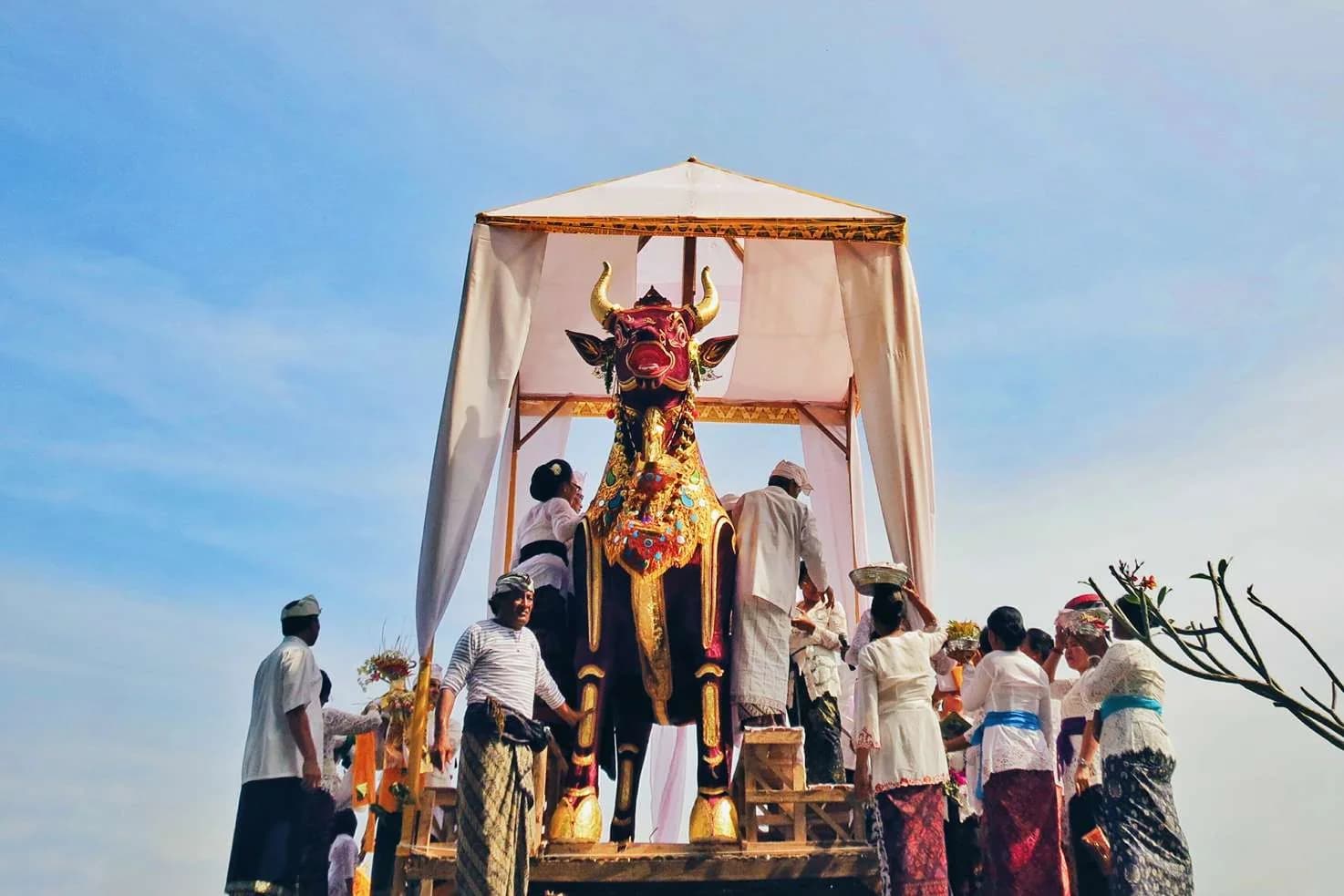
Funeral traditions in Bali may be very different from those in other regions. This tradition is known as Ngaben, in which the body is burned or cremated and the ashes are then released into the sea.
In this article we will discuss the procedures of the ngaben ceremony in Bali, starting from its origins, the purpose of the funeral ceremony, its aims, its types, and how it is carried out.
Understanding Ngaben
Ngaben is a cremation ceremony performed by the Hindu community in Bali to return the soul of a person who has passed away so that it may return to the Creator.
The Origins of the Ngaben Ceremony
The existence of the ngaben ceremony today is actually rooted in Hindu cosmology. Hindu cosmology believes that the human body is made up of natural elements: solid matter, liquid, heat, air, and ether.
These elements form the human body, which Hindus call the coarse body, and it moves because of the subtle body (the human soul).
The subtle body, or atman, is formed from sparks of the Supreme Soul, or God Almighty. Thus, every atman within the human body is a small spark or particle of God.
Hinduism teaches that when a person dies, the soul and mind of that person do not die along with the body, but are meant to return to the Creator.
Meanwhile, the coarse body left behind by its soul becomes a source of suffering for the atman. This is because it cannot return to God as long as its coarse body has not returned to nature.
For this reason, the ngaben ceremony was born to return the elements that form the human body to nature, so that the atman can return to God to face judgment in the afterlife.
The Purpose of the Ngaben Ceremony
The main purpose of the ngaben ceremony is to perfect the passing. The Balinese Hindu community believes that the body of the deceased is indeed dead, but the soul or atman still remains on Earth or even lingers around the home.
So that the atman can return to the Supreme Creator, the ngaben ceremony is performed so that the body of the deceased can return to the elements of nature.
Beyond this, ngaben also has another purpose: to release the atman from worldly bonds, including its bonds with the family. The hope is that the family left behind can soon find peace and let go of the departed.
Types of Ngaben Ceremonies
There are actually many types of ngaben ceremonies. This is because Bali applies the concept of Desa, Kala, Patra, meaning place, time, and circumstance. Every ceremony in Bali, including the ngaben ceremony, follows this concept. Ngaben has several types, as follows.
A. Sawa Wedana
This is the ngaben ceremony that directly involves the intact body of a person who has just been declared dead. The timing of this ceremony usually follows Ala Ayuning Dewasa, or auspicious days according to Hindu tradition.
Before the procession begins, the body is laid out in the family's pavilion or the front room of the house. The family treats the body as if it were still sleeping and offers it provisions such as food, water, coffee, clothing, and a towel.
This usually ends after the Papegatan ceremony, which releases all ties to the body.
B. Asti Wedana
This type of ngaben ceremony involves a body that has already been buried or previously cremated, but whose process was still incomplete or only half finished.
In many areas of Bali, due to financial constraints or other reasons, the ngaben ceremony is often not carried out in full, meaning only half completed. This is known as “Mekingsan Di Setra,” which means entrusted to the cemetery.
For those who have already been cremated, this is known as “Mekingsan di Geni,” meaning entrusted to fire. Usually, a body that has been buried will be exhumed, and the remains are then cremated.
For souls whose cremation was not fully completed, a memukur ceremony is held to complete the ngaben rites so that the atman can return to the afterlife.
C. Swasta
This type of ngaben ceremony does not involve the body at all. It is usually performed for those who are missing, whose bodies could not be found, or who died overseas.
In such cases, the family usually makes an effigy from alang-alang grass or sandalwood shaped like a human figure and inscribed with ancient Balinese script, serving as a symbol of the body of the deceased.
D. Ngelungah
This ngaben ceremony involves a fetus that was lost before birth, and a child who died before losing their baby teeth.
The Procedures of the Ngaben Ceremony
The details of the ngaben ceremony vary from village to village, but in general there are several common steps. These are the procedures of ngaben in Bali.
1. Ngulapin: Marking the Start of the Ngaben Ceremony
Ngulapin is a ritual calling the body to enter the “Sawa,” a symbolic vessel for the soul of the deceased.
2. Ngeringkes
This step includes bathing the body according to the prescribed rules. The purpose is so that the atman may be reborn with a complete body.
3. Ngajum Kajang
This sequence symbolizes that the family and closest relatives are ready to let the body go.
4. Ngaskara
This step carries the meaning of purifying the soul so that it may return to the One Supreme God.
5. Mameras
For a deceased person who has grandchildren, there is usually a mameras procession, meaning the deceased has succeeded and completed their responsibilities in this world.
6. Papegatan
Papegatan means severed. It signifies that the ties between the family and relatives and the deceased have been cut, and that they have sincerely let the body go.
7. Pakiriman
This procession takes place after Papegatan, when the body is placed in a Bade, a tall bier. The family escorts the Bade to the cemetery accompanied by Balinese gamelan music. The family and everyone escorting the body turn the bier three times as a sign of farewell.
8. Ngeseng: The Core of the Ngaben Ceremony
This is the heart of the ngaben procedures, in which the body is cremated. Usually, the ceremony is led by a Pedanda or a Hindu religious leader. After the body has been completely burned, the remaining ashes or bones are gathered, ground down, and placed inside a coconut.
9. Nganyud
Nganyud is the ritual of releasing the remains into the sea. Its purpose is for the impurities of the body to drift away from the world.
Now That You Know the Ngaben Procedures in Bali?
That concludes the explanation of the ngaben ceremony procedures. To this day, there is no funeral service specifically for ngaben, because aside from the large cost of a ngaben ceremony, the process is also quite lengthy and involves many intricate steps full of meaning.
When it comes to funerals, you may need to plan for the day of mourning carefully, just as devoutly as Hindus in Bali perform the ngaben ceremony. So you can use funeral protection from Kamboja to make the funeral process smoother and easier.
Kamboja will help take care of everything, from processing the death certificate, to burial or cremation, to bringing to life the funeral event that you or your loved one wishes for. What are you waiting for? Contact Kamboja now!

dev_kamboja
The Kamboja team writes guides on bereavement, funeral arrangements and funeral planning to help families in Indonesia.


