The Covid-19 pandemic has brought many changes to life, including funeral practices. Here are some tips for funerals during Covid-19, especially for those who have died from the virus or whose status is still PDP (patient under monitoring).
The funerals of Covid-19 patients need careful attention because they cannot be done carelessly. There are rules and procedures that must be followed. These rules are issued by the Indonesian Ministry of Health and the WHO. Here is more information about funerals during the Covid-19 pandemic.
Criteria for Bodies That Fall into the Covid-19 Category
There are special methods and tips for handling the funeral of a body exposed to the Covid-19 virus. For this reason, you need to know what criteria classify a body as a Covid-19 body. Here are several criteria for the bodies of Covid-19 patients:
- A body that is suspected or presumed (suspect) to have been exposed to the Corona virus within a hospital before the results of its swab test are out.
- The body of a patient from within a hospital who has been confirmed as having been exposed to the Corona virus, or as a probable.
- case. A body from outside a hospital with a history of, or meeting the criteria for, a probable case or a confirmed Corona case. This criterion also includes DOA (Death on Arrival) patients who were previously referred from another hospital.
If a body falls into any of the three criteria above, its funeral must be carried out according to the established procedures. This is done to prevent unwanted transmission and spread.
In some areas, there were cases of Covid-19 bodies being refused burial in the early days of the pandemic. This was certainly wrong, because bodies must still be buried even if exposed to Covid-19, in line with the Islamic law on burial, which is fardu kifayah (a collective obligation).
If someone dies in an area, there must be people who carry out the obligation of burying the body. If this is not done, or the body is refused as in some cases, then everyone in that area will bear the sin.
However, during this pandemic our duty is to obey the health protocols and existing rules, so the funeral of a Covid-19 patient is best left to be handled according to those rules.
Procedures and Tips for Funerals during Covid-19
Funeral processes generally take a long time because religion has its own procedures that must be followed. However, during a pandemic, which can be considered an emergency condition, the burial process is simplified.
In Islam, some scholars classify a pandemic as a calamity; therefore, it is permissible to bury the body in a faster way. This is done solely for the common good, concerning the safety of many people.
According to the regulations on the Protocol for Handling the Bodies of Covid-19 Patients issued by the WHO, the procedures for burying a body are as follows.
-
Process of Washing the Body
The provisions on handling a Covid-19 body before burial are as follows:
- Only health workers may handle the funeral of a Covid-19 patient's body.
- Workers are required to wear protective clothing, a mask, gloves, and goggles. Workers are also prohibited from eating, drinking, or touching their faces while in the preparation room or in the area where the Covid-19 patient's body is viewed.
- Before being moved to the mortuary, the body must be completely wrapped in a body bag that is opaque. There must be no leakage of body fluids that could contaminate the outside of the body bag. Immediately after death, move the body to the mortuary as soon as possible. The patient's family is allowed to view the body one last time before it is placed in the bag, provided they wear PPE. Workers must explain to the family the protocol for handling bodies of those who died from infectious diseases such as Covid-19. Embalming or preserving the body is prohibited.
- The worker washing the body must be of the same sex as the deceased, and the body is washed without removing its clothing. If no worker of the same sex is available, then an available worker may do it. However, the requirement is that it be washed without removing the clothing, or it may be performed with tayammum. Before washing the body, the worker must clean away any najis (impurity) or dirt, if present.
The washing may be done by pouring water evenly over the whole body. If, in the judgment of experts, washing the body is not possible, it may be replaced with tayammum in accordance with Islamic law, namely:
- Wiping the face and both hands of the body with dust, at least up to the wrists.
- Workers continue to use PPE while wiping the body.
- If it is still not possible to wash or perform tayammum, then under Islamic law, in an emergency, the body may be neither washed nor given tayammum.
-
Process of Wrapping the Body
After the body has been washed, given tayammum, or neither, the next tip for funerals during Covid-19 is that the body must be shrouded and wrapped in plastic, under the following conditions:
- After the body has been shrouded and wrapped in plastic, it must be sprayed with a chlorine solution as a disinfectant. The body is then placed in a body bag that is watertight and secure so that the virus does not spread and the safety of workers is protected. If the deceased is Muslim, the body must be placed on its right side in the coffin, so that when buried it faces the qibla.
- It is prohibited to reopen a body that has been wrapped. However, in urgent circumstances such as an autopsy, the wrapping may be reopened, and this may only be done by workers who have received permission.
- The body must be buried no later than 4 hours after death. The body must be transported to the cemetery in a hearse.
- The funeral prayer (salat jenazah) will be performed if the deceased is Muslim, under the following conditions:
- The funeral prayer is held at a designated referral hospital or at a place that has undergone a thorough sanitation inspection. Once the funeral prayer is finished, the location must be disinfected.
- Given the maximum time limit for keeping the deceased at the place of rest, which is 4 hours at most, the funeral prayer should be carried out as soon as possible.
- The funeral prayer may be performed by just one person.
-
The Burial Process
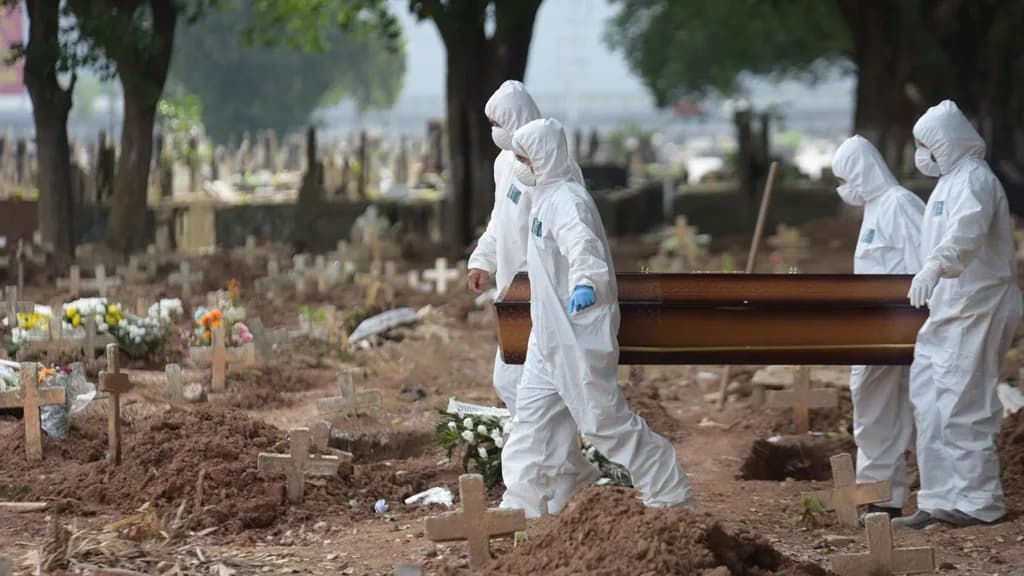
The COVID-19 funeral tips continue with the burial process. The following procedures must be applied when burying the body of a COVID-19 patient:
- The burial site must be more than 50 meters away from any water source used by the community for daily needs, and more than 500 meters from the nearest residential area. The grave must be more than 1.5 meters deep and covered with soil to a height of 1 meter.
- The coffin, shroud, and plastic wrapping must all be buried together with the deceased.
- Family members may attend the burial once all procedures have been carried out properly, provided they continue to wear protective equipment to avoid exposure to the virus.
- All officers who have taken part in the funeral process, from the preparation of the body through to burial, are required to undergo sterilization. The officers will be sprayed with disinfectant on their clothing and must always wash their hands.
The procedures and COVID-19 funeral tips above are more than just rules to follow; they are about the safety of the officers carrying them out. Therefore, if you are a family member of a patient, please comply with and respect the policies in place.

dev_kamboja
The Kamboja team writes guides on bereavement, funeral arrangements and funeral planning to help families in Indonesia.