A Complete Guide to the Banten Offerings Used in Ngaben Ceremonies
- Kamboja Blog
- (updated )
- 6 min read
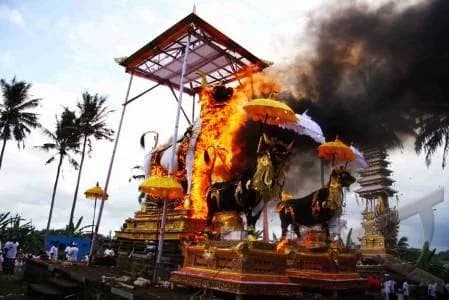
In the context of funeral services in Bali, the Ngaben ceremony is not merely a procession for releasing the body, but a sacred ritual rich in spiritual meaning. One of the most important elements of this ceremony is the banten, or offering. It serves as a means of presenting offerings to Ida Sang Hyang Widhi Wasa and His manifestations, to ancestors, and to the universe.
For many people, the term banten, its various types, and its functions can seem complicated. In this article, we will cover in full what the Ngaben ceremony is, what banten are, and the complete list of banten used in the Ngaben ceremony, along with their explanations.
What Is the Ngaben Ceremony?
The Ngaben ceremony is a cremation ritual in Balinese Hindu tradition. Its main purpose the procedures of the Ngaben ceremony is not simply to send off the deceased, but to free the soul from earthly bonds so that it may return to its origin and continue its journey toward a higher realm.
In Balinese Hindu belief, the human body is made up of the Panca Maha Bhuta (earth, water, fire, air, and ether). Through Ngaben, these elements are returned harmoniously to the universe, while the atma is released through prayers and offerings.
Ngaben is also the family's final act of devotion to the deceased, and an expression of spiritual responsibility so that the soul does not remain bound to the sekala (the material world).
What Is Banten or Seserahan?
Banten are sacred offerings used in every Balinese Hindu traditional and religious ceremony, including Ngaben. Banten are not merely "sesaji" (offerings), but a means of spiritual communication between humans and God, ancestors, and the forces of nature.
Each banten has:
- A specific form
- Particular contents
- Symbolic meaning
- Different ritual functions
In the Ngaben ceremony, banten serve as:
- Means of purifying the soul
- Spiritual provisions for the atma's journey
- Expressions of the family's devotion and sincere feeling
- A balance between the sekala and niskala (the unseen) realms
Types of Banten Used in the Ngaben Ceremony
Below is a complete list of the banten commonly used in the Ngaben ceremony, although the number and types may vary depending on the traditional village (desa adat), the level of the ceremony, and the family's means.
1. Mewangun Pengabenan Ceremony
Ngaben mewangun can be considered one of the most complete forms of Ngaben. In this type, the human body is regarded as a single "structure" (awangun), so each part of the body receives its own symbols and ceremonial offerings. For this reason, the ceremony is quite extensive and complex.
Ngaben mewangun is always accompanied by the pengaskaran ceremony, a procession for purifying the soul.
There are two types of Mewangun Pengabenan:
a. Mewangun Sawa Pratek Utama
This is the Ngaben that uses the actual body of the deceased (sawa or watang matah). The entire sequence of the ceremony is carried out in the presence of the body, so it is considered the most complete in physical form.
b. Mewangun Nyawa Wedana
In this type, there is no body. Instead, a symbol of the human body is made from sandalwood, drawn upon and inscribed with sacred script (aksara sangkan paran).
The term Nyawa Wedana means:
- Nyawa / nyawang → a symbol is made
- Wedana → form or embodiment
So, Nyawa Wedana is a Ngaben in symbolic human form, usually held when the body is absent or the person passed away long ago.
2. Pranawa Pengabenan Ceremony
The Pengabenan Pranawa focuses on the nine main openings of the human body, which are believed to be the pathways through which good and bad influences enter and leave during a person's life.
The word Pranawa comes from:
- Prana → opening, breath, path of life
- Nawa → nine
The Nine Openings in the Pranawa Concept
These nine openings are believed to lead a person toward goodness or toward sin, depending on how they lived:
- Udana (forehead): Related to the quality of one's thoughts.
- Kurma (eyes): Influences wisdom and one's outlook on life.
- Krkara (nose): Connected to honesty and Tri Kaya Parisudha.
- Prana (mouth): Many sins originate from speech (Tri Mala Paksa).
- Dhananjya (throat): Influences arrogance and disobedience.
- Samana (solar plexus): Connected to greed and covetousness.
- Naga (stomach): Related to Sad Ripu (the six enemies within).
- Wyana (joints): Influences good and bad deeds (karma).
- Apana (anus & genitals): Connected to desire and Sapta Timira.
Because it is considered very important, the Pengabenan Pranawa is always accompanied by pengaskaran.
Five Types of Pengabenan Pranawa
- Sawa Pranawa
Uses the body or watang matah.
- Kusa Pranawa
May use the body or only a symbol (scene). The body symbol is made from special woven material and is accompanied by pengaskaran.
- Toya Pranawa
Similar to Kusa Pranawa, but the symbol contains holy water (toya) as a sign of purification. Pengaskaran is still used.
- Gni Pranawa
A simpler version. The pengaskaran is carried out in a simple (nista) manner at the setra. Many of the large Ngaben equipment items are not used. The focus is on the cremation and the release of the soul.
- Sapta Pranawa
Can be held at home or directly at the setra. Does not use bale paga when carrying the body. There is also a version cremated (buried), not burned.
3. Pengabenan Swastha
Pengabenan Swastha is a simple Ngaben at the smallest scale, as it does not use pengaskaran. This means many of the large Ngaben accessories are not used.
What is usually used is only:
- Coffin
- Pepaga or penusangan
- Procession directly at the setra
Meaning of the word Swastha:
- Su → primary, good
- Asthi → bones or ashes
In other words, this Ngaben returns to its essence: simple, yet still deeply meaningful.
The types of Pengabenan Swastha are divided into:
1. Swastha Geni
The body is cremated (or there is no body). After that, a single sekah is made, followed by the sending-off ceremony and nganyut. Once this is complete, the series of rites ends.
2. Swastha Bambang
The body is not cremated but buried. All the procession takes place above the bambang (burial site). There is no nganyut, but the purification rituals are still carried out as in a regular Ngaben.
3. Pengabenan Kerthi Parwa
Intended for Hindus who fall in battle. It does not use pengaskaran, only ngentas and sending-off. The procedure is similar to Swastha Geni.
4. Pengabenan Ngelanus
Strictly speaking, ngelanus is not a type of Ngaben but a way to speed up the Ngaben process. There are two forms:
a. Ngelanus Tandang Mantri
All the Ngaben and pemukuran procession is completed in a single day. This is specifically for wiku or sulinggih, not for ordinary people (walaka).
b. Ngelanus Tumandang Mantri
This is carried out for walaka, usually completed within one to two days. The number and type of upakara are adjusted to the family's capacity.
Do All Ngaben Use the Same Banten?
Not always. The type and number of banten in a Ngaben ceremony depend greatly on:
- The local village custom (desa adat)
- The level of Ngaben (simple, madya, utama)
- The family's economic condition
- Agreement with the pemangku or sulinggih
What matters most is not the lavishness of the banten, but the sincerity of intention and the prayers that accompany it.
Complete Funeral and Body Handling Services, Hassle-Free
Kamboja is a trusted solution for comprehensive body handling and funeral services, so families do not need to struggle with the many technical matters, including the body transfer process, which often requires special handling.
From administrative arrangements and funeral coordination to support throughout the process, everything is handled professionally and with empathy. For more complete service information, please visit the page body handling services.
If you need assistance or would like further consultation, please don't hesitate to contact Kamboja Customer Service on WhatsApp at 082211111415 or +62 815-1353-2488. We are ready to help you when you need it most.
- #funeral services

Kamboja Blog
The Kamboja team writes guides on bereavement, funeral arrangements and funeral planning to help families in Indonesia.