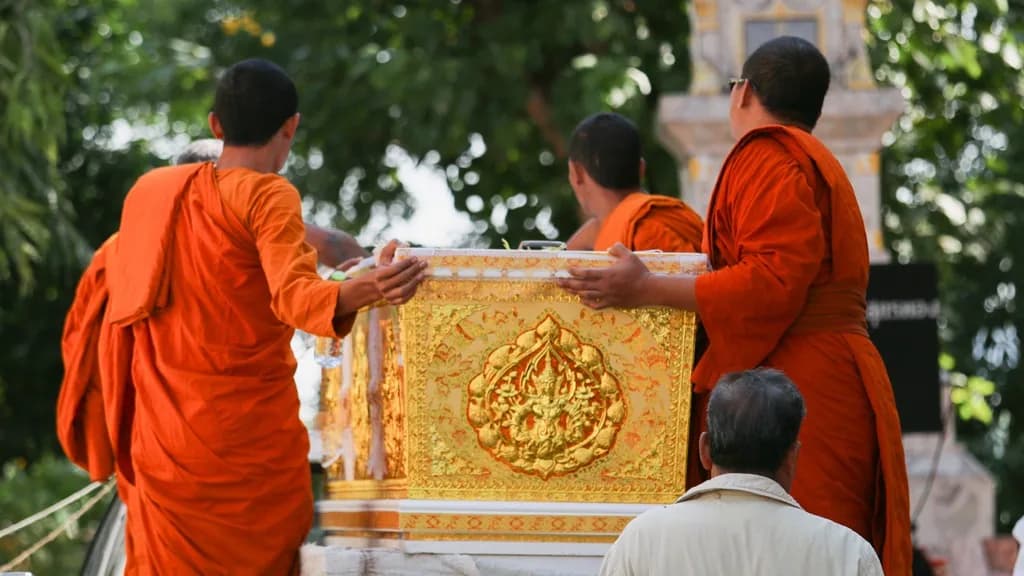
Cremation, or burning the body after death is not a new practice in Indonesia, given that the country is home to a wide variety of religions and ethnic groups. Buddhist cremation is the ceremony we see most often.
However, a question arises about this practice: is cremation actually a required ceremony in Buddhism? To find the answer, read the information below.
Is Cremation Required for Buddhists?
In Balinese Hindu teaching, the process of cremating the body is called Ngaben, and it is obligatory for every follower of that religion.
Buddhism, on the other hand, does not require it. This is shown by the beliefs of Buddhist traditions in ancient times, so the traditions carried down to today still exist.
However, according to Gautama Buddha, he instructed his disciples well in advance to carry out a special cremation ceremony after his Parinibbana. The Buddha's practice of cremation certainly had its own purposes, which is why he did not include it in the Tripitaka.
The Tripitaka does not mention this, and it is not required for other Buddhist disciples. In general, those who choose cremation seem to do so based on the tradition of Indian society, which cremated the dead.
In addition, several factors behind cremation in Buddhism include:
-
Buddhist Cremation in Ancient India
In ancient India, the local people often cremated the bodies of deceased family members. Before the ceremony of honor was held, the body was first wrapped in cloth and adorned.
After the ceremony of honor was completed, the body was then cremated using wood. Once the body had burned away and become ash, the ashes were then scattered in a water source or stored in a specific place.
Usually, the cremated ashes were scattered in the Ganges River, which Indian society regards as sacred.
-
The Buddha's Decision to Leave Relics
The Buddha's decision to be cremated may also have been motivated by his wish to leave relics. Buddhist accounts state that the Buddha would bequeath relics after his body became ash.
These relics take the form of small fragments of stone and are the physical remains of the Buddha.
The purpose of the Buddha leaving these relics was to provide an object for disciples to venerate, especially disciples who had never met the Buddha in person.
In this way, a strong faith would arise among disciples who were studying and practicing what the Buddha had taught.
From these two backgrounds, it can be concluded that apart from his own case, the Buddha did not recommend that his disciples perform any particular funeral ceremony. Therefore, cremation in Buddhism is not required, because it is not a recommendation from the Buddha.
Changes in Buddhist Cremation Ceremonies
Although cremation is not obligatory, it is a choice for Buddhists. For that reason, just because the Buddha did not recommend it does not mean Buddhists are forbidden from doing it. They are free to choose cremation or simply be buried after death.
Usually, families who perform cremation do so because it has become a hereditary tradition. Cremation may also follow the wishes of a person who, while alive, asked to be cremated after death.
Because cremation is mostly a tradition rather than a direct command from the Buddha, it can change over time. Ceremonies from earlier times differ somewhat from today's, from the equipment used to the procedures followed.
Some differences between past and present cremation ceremonies include:
-
More Advanced Equipment
In the past, equipment was limited, so the cremation process still used traditional tools. Unlike Balinese Hindus, who keep the Ngaben tradition of burning the body, Buddhists appear to be more flexible.
Whereas cremation was once carried out with firewood, it is now done in special cremation ovens. The temperature of these ovens is very high, which is why a body placed inside turns to ash quickly.
In general, cremation rites at dedicated facilities also follow their own procedures, such as bathing the body beforehand, and so on. More advanced equipment for cremation may appear in the future.
Even though advanced equipment exists, some Buddhist communities still preserve the tradition of traditional cremation using firewood, like the Ngaben ceremony in Bali.
-
Faster Process
Because special ovens are used, the cremation process is naturally faster. On average, cremating a body in an oven takes about 2 hours. In the past, when firewood was used, the process took much longer.
Cremation ceremonies once took hours to make sure the body had turned to ash. Moreover, the more complicated rituals made the overall ceremony last longer than cremation today.
-
Simpler Procedures
Another difference between Buddhist cremation today and in the past lies in the procedures used. Today's procedures are simpler and more concise, from the equipment to the cremation rites themselves.
For example, Chinese Buddhists who still observe the Coffin Closing ceremony (Cit Bok), the Flower Night (Mai Song), and other days of mourning have simplified the order of their rites.
In contrast, past cremation procedures were more complicated, with many rules and attributes used in the ceremony. As a result, cremation ceremonies today can be carried out by anyone and in a short time.
Cremation in Other Religions
Some religions other than Buddhism may not teach cremation but allow it, while others firmly prohibit cremation of the dead, Islam being one of them.
For followers of religions that permit it, cremation may be chosen for reasons of convenience or because the deceased wished it while alive. Many families ultimately choose cremation because they do not want the family grave to be neglected if it is not visited often.
In addition, many people who deeply love someone who has passed away prefer cremation so they can keep the ashes at home. This is perfectly acceptable as long as the person's religion does not forbid it.
In Islam, cremation is prohibited because they believe that a body, even after washing, can feel pain if touched by the living.
That is why, when washing the body, the back of the hand must be used carefully.
From the discussion above on whether cremation is required for Buddhists, it can be concluded that cremation is a choice, not an obligation. Tradition and the wishes of the deceased can also be reasons why a body is cremated.
Kamboja provides funeral services and cremation arrangements according to your wishes, and offers funeral protection for you.

dev_kamboja
The Kamboja team writes guides on bereavement, funeral arrangements and funeral planning to help families in Indonesia.


