Crematorium: Its History and How It Differs from a Columbarium
- Kamboja Blog
- (updated )
- 6 min read
When saying goodbye to a loved one, every family has its own way and its own choices. Some choose burial, while others choose cremation. Before deciding, it is very important to understand what a crematorium really is, how its history began, and how it differs from a columbarium, which is often mentioned alongside it.
Many people still assume the two are the same, but their functions and facilities are different. To avoid confusion, let's go through a complete and easy-to-understand explanation of the crematorium, its history, how it differs from a columbarium, and the facilities usually available there.
So, What Is a Crematorium?
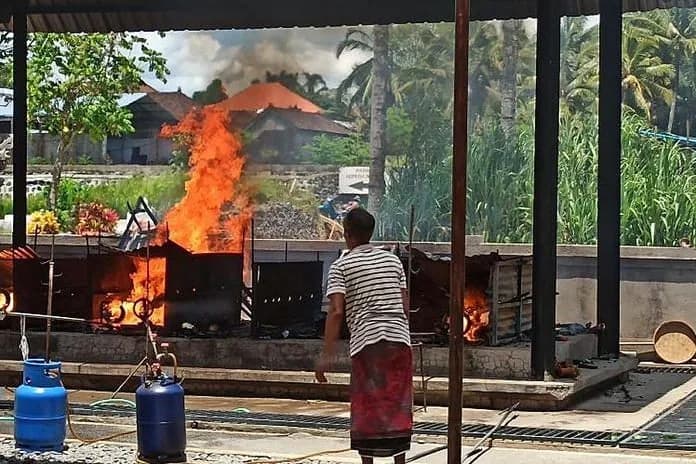
A crematorium is a special place equipped with a furnace or combustion machine for carrying out the cremation process of a body. This is where the burning takes place safely, in an enclosed space, and according to established procedures. The word crematorium itself comes from the Latin cremare which means “to burn”.
The term became popular in Europe and the United States in the late 19th century, specifically in the Victorian era. Back then, crematoria were typically described as large brick buildings with tall chimneys to vent the smoke from the burning process.
In the 19th century, cremation began to be regarded as a primary method of handling bodies, mainly for reasons of hygiene and efficient use of land. As time went on, the design of crematoria became more modern.
Today, a crematorium is not just about the furnace. It usually also has family waiting rooms, ceremony halls, and other supporting facilities so that families can feel comfortable during the moment of farewell.
The History of the Crematorium
Looking far back, the history of the crematorium actually began in ancient times. In fact, the practice of cremation has existed since prehistoric times. Here is a brief overview of its development over the ages.
1. Ancient Times
In various ancient civilizations such as Egypt, Greece, and Rome, cremation was already known as one way of paying final respects to the deceased.
Archaeological evidence also shows that the practice of cremation existed as far back as the Pleistocene era.
In other words, long before modern crematorium buildings existed, humans already knew the method of burning bodies as part of death rituals.
2. The Middle Ages
As the Middle Ages took hold in Europe, cremation was gradually abandoned. The Roman Catholic Church at that time regarded cremation as an act that did not respect the human body.
Because the body was believed to be the dwelling place of the soul, burial in the ground became the more common and widely accepted choice.
3. The 19th Century
In the 19th century, cremation began to make a comeback. In India, cremation had long been an important part of Hindu teachings.
Meanwhile, in Western countries, cremation began to be considered as a solution to health and sanitation problems caused by the less hygienic practice of ground burial. From this idea, the concept of the modern crematorium began to develop.
4. The Founding of Modern Crematoria
The first modern crematorium was established in Milan, Italy, in 1876 by Professor Paolo Gorini. A few years later, in 1885, the first commercial crematorium was built in Woking, England.
In Japan, the practice of cremation also grew rapidly under the influence of Buddhist teachings. Although it was briefly banned in 1873 during the Meiji era of modernization, the ban was lifted two years later.
As the population grew and land became scarce, cremation was once again accepted and became a common practice in Japan.
5. The 20th Century to the Present
Entering the 20th century, cremation became increasingly accepted. The Catholic Church, which had initially rejected cremation, gradually softened its stance and officially permitted it, though certain rules still apply.
Urbanization, limited burial land, and growing environmental awareness have made cremation an increasingly popular alternative in many countries.
In Indonesia, cremation is generally practiced by Buddhists and Hindus. Among Christians and Catholics, views on the practice still differ, although in general it has become more open than in the past.
The Difference Between a Crematorium and a Columbarium
Many people still often confuse a crematorium with a columbarium. Yet their functions are different, you see. In short, a crematorium is a place where the process of cremation, or the burning of a body, is carried out.
So this is where the main process takes place until the body is transformed into ashes. A columbarium, on the other hand, is a place to store the ashes after the cremation process is complete.
It usually takes the form of a building with rows of small rooms or lockers (niche) where urns of ashes are kept neatly and in order. So while a crematorium focuses on the process, a columbarium focuses on storage.
What Facilities Are Available at a Crematorium?
Today, crematoriums are far more modern and comfortable than they once were. They do not just have a cremation furnace; they are also equipped with a range of supporting facilities so that families can feel at peace while saying goodbye to a loved one. Here are some of the facilities commonly found at a crematorium:
A. Ceremony Hall or Viewing Room
Many crematoriums provide a dedicated space for farewell ceremonies. Here families can hold joint prayers, religious services, or traditional rites before the cremation takes place. These rooms are usually calm, clean, and neatly arranged to keep the atmosphere solemn.
B. Family Waiting Room
Because the cremation process takes time, a comfortable waiting room is usually available for families. These facilities may include chairs, air conditioning, drinking water, and even private rooms so that families can rest in peace.
C. Modern Cremation Furnace
This is the main facility. Cremation furnaces today use advanced technology that is safe, efficient, and in line with environmental standards. The process is carried out in an enclosed setting by trained professionals.
D. Ash Handover Room
Once the process is complete, the ashes are collected and placed into an urn. There is usually a dedicated room for handing the ashes over to the family, so that this moment remains respectful and orderly.
E. Urn Provision
Many crematoriums offer a choice of urns in various designs and sizes. Families can choose what suits their needs, whether for keeping at home, placing in a columbarium, or for a sea scattering ceremony. urn (see above)
Make the Best Decision for Your Family!
Now we know that a crematorium is a specialized facility for the cremation process, which has been used since ancient times and has continued to develop into the modern services we see today. Unlike a columbarium, which functions as a place to store ashes, the crematorium focuses on the cremation process itself.
Kamboja offers comprehensive funeral services and body care services so families do not need to handle every technical matter such as burial or cremation themselves. From collecting the body and preparation through to the farewell ceremony, everything is handled professionally and with great empathy.
With this service, families can focus on grieving and remembering their loved one without the stress of logistics or paperwork. For further information and consultation, you can contact us directly via WhatsApp at +6282211111415.
- #funeral services
- #jasa kremasi
- #kremasi

Kamboja Blog
The Kamboja team writes guides on bereavement, funeral arrangements and funeral planning to help families in Indonesia.