In the midst of grief, many families are still unsure about what is and is not permitted when caring for a loved one's body. Some traditions that have developed in the community also lack a firm basis in the Qur'an or the Sunnah.
For this reason, it is important for Muslims to understand the various prohibitions in funeral rites so that the burial proceeds in accordance with Islamic teachings.
In this article, we will discuss 5 prohibitions in Muslim funeral rites based on the Sunnah. Let us take a look.
5 Prohibitions in Muslim Funeral Rites Based on the Sunnah
Islamic funeral arrangements aim not only to honor the deceased but also as an act of obedience to Allah SWT. Therefore, every step taken should follow the guidance of the Prophet Muhammad SAW and avoid practices that contradict Islamic law.
1. Excessive Lamentation at Death (Niyahah)
Weeping over the loss of a loved one is a human and permissible response in Islam. The Prophet SAW himself wept when he lost members of his family. However, what is forbidden is excessive lamentation, such as:
- Screaming hysterically
- Beating one's body
- Slapping one's face
- Tearing one's clothes
- Saying words that show dissatisfaction with the decree of Allah
Such behavior is considered contrary to the patience that Islam encourages. When calamity strikes, a Muslim is encouraged to say:
"Inna lillahi wa inna ilaihi raji'un."
These words remind us that all people come from Allah and will return to Him.
2. Delaying the Burial Without a Legitimate Reason
The next prohibition is delaying the burial without a reason justified by Islamic law.
Many hadiths state that the body should be buried promptly once washing, shrouding, and the funeral prayer are complete. The Prophet SAW encouraged Muslims not to prolong the burial process.
Delays usually happen for reasons such as:
- Waiting for family members who live far away
- Waiting for a particular day considered auspicious
- Waiting for more mourners to gather
- Waiting for certain customary ceremonies
If there is no urgent need, such practices should be avoided. Islam teaches simplicity and promptness in funeral arrangements.
3. Burdening the Grieving Family with Large Feasts
In some regions, the grieving family is expected to prepare large quantities of food for the guests who come to pay their respects.
Yet, based on a number of narrations and the explanations of scholars, it is neighbors and relatives who are encouraged to help provide food for the grieving family.
This is because a family that has lost a member is usually in a difficult emotional state and needs support, not additional burdens.
Holding large meals that weigh heavily on the grieving family should be avoided, especially if they lead to debt or financial hardship.
Instead, Muslims are encouraged to:
- Help meet the needs of the grieving family
- Send food
- Assist with the funeral arrangements
- Offer moral support
4. Performing Practices Without a Basis in Islamic Law
The next prohibition is performing rituals or customs that have no clear foundation in Islamic teaching. In some communities, there are beliefs linked to death, for example:
- Setting specific days as obligatory for certain rituals
- Beliefs that certain objects must be placed with the body
- The belief that the spirit will return at a certain time
- Mystical practices that have no basis in Islamic law
Islam teaches that all acts of worship must have a clear basis in the Qur'an and the Sunnah.
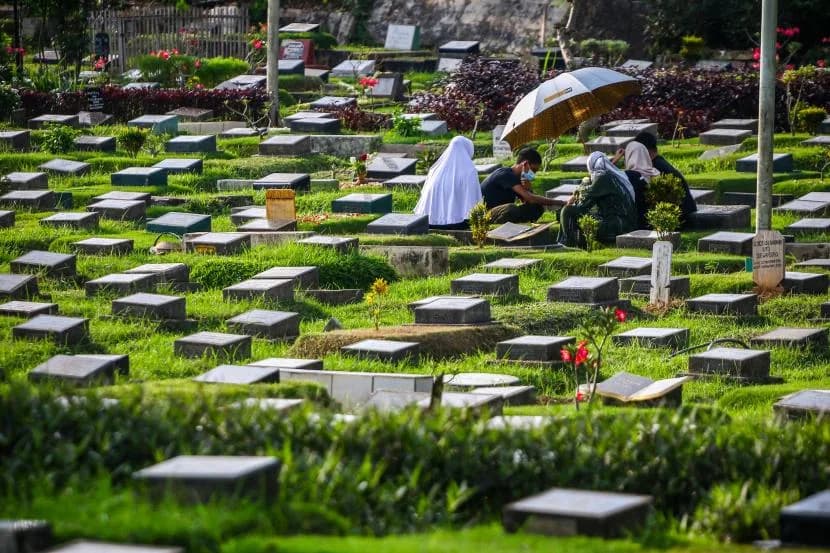
5. Excess in Building and Decorating Graves
The final prohibition to understand is excess in constructing graves.
One question that comes up fairly often concerns the ruling on tiling graves. In practice, scholars have their own discussions regarding grave construction.
In general, Islam encourages simplicity in burial and forbids excess that turns the grave into a source of pride or luxury.
The purpose of a grave in Islam is to serve as a resting place for the deceased and as a reminder to the living of death and the hereafter.
For this reason, the main focus should not be on the grandeur of the grave, but on the prayers and righteous deeds that continue to flow to the deceased.
Cremation in Islam: Is It Permitted?
Another topic that is frequently asked about is cremation in Islam.
In general, the majority of scholars hold that a Muslim's body must be buried and not cremated. This is because the practice modeled by the Prophet SAW was to bury the dead, not to burn them.
The human body is regarded as having dignity both during life and after death. Therefore, burial is an important part of Islamic law.
For Muslim families, funeral arrangements should follow the procedures taught in Islam, from washing the body through to burial.
Funeral Arrangements Should Follow the Sunnah!
While a family is grieving, the many practical needs of a funeral can be a challenge in themselves. Kamboja.co.id is a funeral service provider that helps families handle these needs professionally.
With the help of an experienced team, families do not have to struggle with logistical details and can focus more on praying for and accompanying their loved ones. More information is available through the Kamboja.co.id Funeral Services.
To make it easier for you to ask questions, you can contact Kamboja.co.id via WhatsApp at +6282211111415.
- #funeral services

Kamboja Blog
The Kamboja team writes guides on bereavement, funeral arrangements and funeral planning to help families in Indonesia.