The passing of a family member naturally brings sorrow to those around them. The family then organizes a funeral ceremony full of meaning to bid them farewell.
In Indonesia, every ethnic group, religion, and region has its own unique way of holding funeral ceremonies. One of them is the series of rites found in Buddhist funerals.
The procession of funeral customs in Buddhism is deeply rooted in ancestral belief. For this reason, the ceremonial process is naturally different from funerals in Indonesia in general, which are usually much simpler and more concise. Today, when a member of a Buddhist family passes away, the process generally goes something like this:
Preparation Series for a Buddhist Funeral
The body of the deceased Buddhist is bathed using 5 kinds of flowers and white liquor, and dressed in their finest clothes, complete with the shoes they owned while alive.
The body is then covered with a red blanket if the deceased reached the age of 80. For those who were younger, a white, green, or other colored blanket may be used instead.
Clothing the deceased wore during their life is also placed in the coffin. The bed the deceased used to sleep in every day must be dismantled. The pillows, mattress, bolster, and blankets they commonly used are aired out in the attic or the front yard of the house.
A broken mirror is also placed above the body, as a sign that their life in this world has ended.
The Coffin Closing Procession
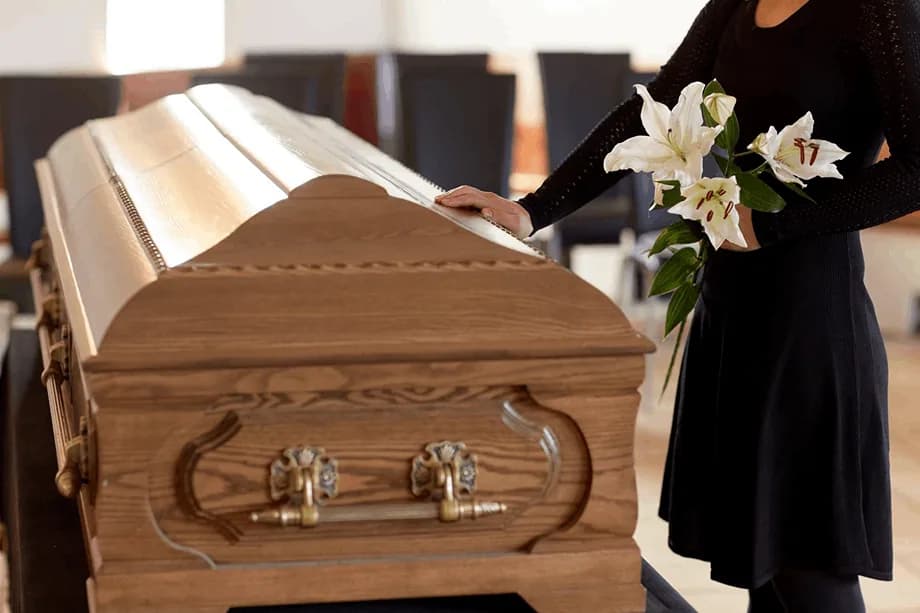
In the Buddhist funeral process, before the coffin is closed, the spouse, children, relatives, and the deceased's extended family walk around the coffin, taking turns sprinkling fragrant oil.
Then the deceased's children stand around the head of the body to place pearls in the 7 openings, the 4 senses, which consist of 2 ear openings, 2 nostrils, 2 eyes, and 1 under the tongue.
If it is difficult or not possible to obtain pearls, cotton may be used instead. The purposes of placing the pearls include:
- If the deceased is only in a state of suspended animation, the pearl or cotton placed in one of those openings will come loose on its own.
- Whether we realize it or not, after the parents return to a different dimension, there is often suspicion, disagreement, and quarrels among siblings that can lead to family disputes.
- By placing pearls in the 4 senses, the deceased's children implicitly promise to become wiser, more patient, and more tolerant people, and to show greater affection toward their own siblings.
After the pearl placement is complete, the deceased's children move to face the coffin at its foot. The position taken is the full kowtow, in which the face must touch the floor.
This same posture is also followed by the spouse, the deceased's younger siblings, and all grandchildren, great-grandchildren, and nieces and nephews.
If the deceased still has living parents, it is best that the parents do not escort the body through this procession. In principle, the elderly are not permitted to escort the young.
The Coffin Lid Closing Procession
At the time of the funeral procession in Buddhism, when the coffin is closed, the deceased's children perform the kowtow 2 times right in front of the coffin. The eldest son nails the nails, led by the tekong holding the hammer. The tekong holds the eldest son's hand and recites several accompanying phrases while striking the nails into the coffin. A total of 4 nails are installed, each struck once.
If the deceased already has great-grandchildren, then a fifth nail may be installed. This fifth nail is smaller than the previous 4 nails. For the fifth nail, 3 red cloths and 2 white cloths cut into circles must be prepared. Right in the center of these cloths the fifth nail is placed and nailed on the upper three-quarter section of the coffin, close to the deceased's head.
After that, the tekong tightens the nails, and then the procession ends by pouring liquor onto the floor 3 times. The meaning of this pouring is that the eldest son has received the outpouring of love from the deceased and promises to look after the family until the end of life.
The Prayer Procession in a Buddhist Funeral
The eldest son of the deceased lights a pair of white candles and burns a large incense stick with a green handle. The incense is then planted in the incense burner.
The incense must not be allowed to go out, and it must be replaced promptly when nearly burned out. White candles are used only for those who passed away at the age of 70 or younger.
For those aged 70 and above who already have grandchildren, red candles are used. Nevertheless, if the family wishes to use white candles, this is still permitted, since in Buddhist funeral tradition white is a symbol of grief.
Offerings
Offerings of cakes, fruit, food, and tea are placed on the prayer table or altar. The most important element in a Buddhist funeral procession is three layers of pork, milkfish, and a whole chicken, all cooked by boiling.
The pork in this ceremony symbolizes the man or father who must work hard to support his family, while the fish symbolizes the woman or mother who is tasked with educating and caring for her children.
The chicken symbolizes the children, who are hoped to one day be able to fly over their boundary fences. As for the cakes offered, they should be cheerful in color and sweet in taste, and glutinous rice ingredients are not recommended. The cakes usually served are lapis cake, bugis cake, mangkok cake, and banana cake.
The fruits served must not be thorny. Varieties include apples, bananas, pineapples peeled of their sharp skin, and oranges.
How to Dress
For the family members left behind, they usually wear toaha garments made of white blacu cloth and a headband in a matching color.
The clothing is also reversed, so the outer layer is worn inside and the inner layer is worn outside. After the Buddhist funeral procession is complete, the clothes worn are burned.
Placing Ten Lung Lamps and Oil Lamps
On the upper left and right sides of the entrance to the mourning room, white Ten Lung lamps are usually hung, bearing the age and family name of the deceased. A white cloth is hung at the entrance. This signals that the room is a place of mourning.
In addition, a small mat is laid on the floor to the left of the coffin. On the mat is placed a small burning oil lamp, and a paper money burner is set near the coffin, at the head of the deceased.
That concludes this overview of Buddhist funeral customs. Because many of these rituals are closely tied to expenses, some Buddhists also prepare funeral insurance well in advance of their passing. This is not a wish for death to come sooner, but rather a way to ease the burden on those left behind.
Kamboja provides funeral services to lighten your load, so you can focus on the emotional bonds with your family during a time of grief.

dev_kamboja
The Kamboja team writes guides on bereavement, funeral arrangements and funeral planning to help families in Indonesia.