Sumba Funeral Rites in Tanah Marapu: The Tradition of Keeping the Deceased at Home
- Kamboja Blog
- (updated )
- 7 min read
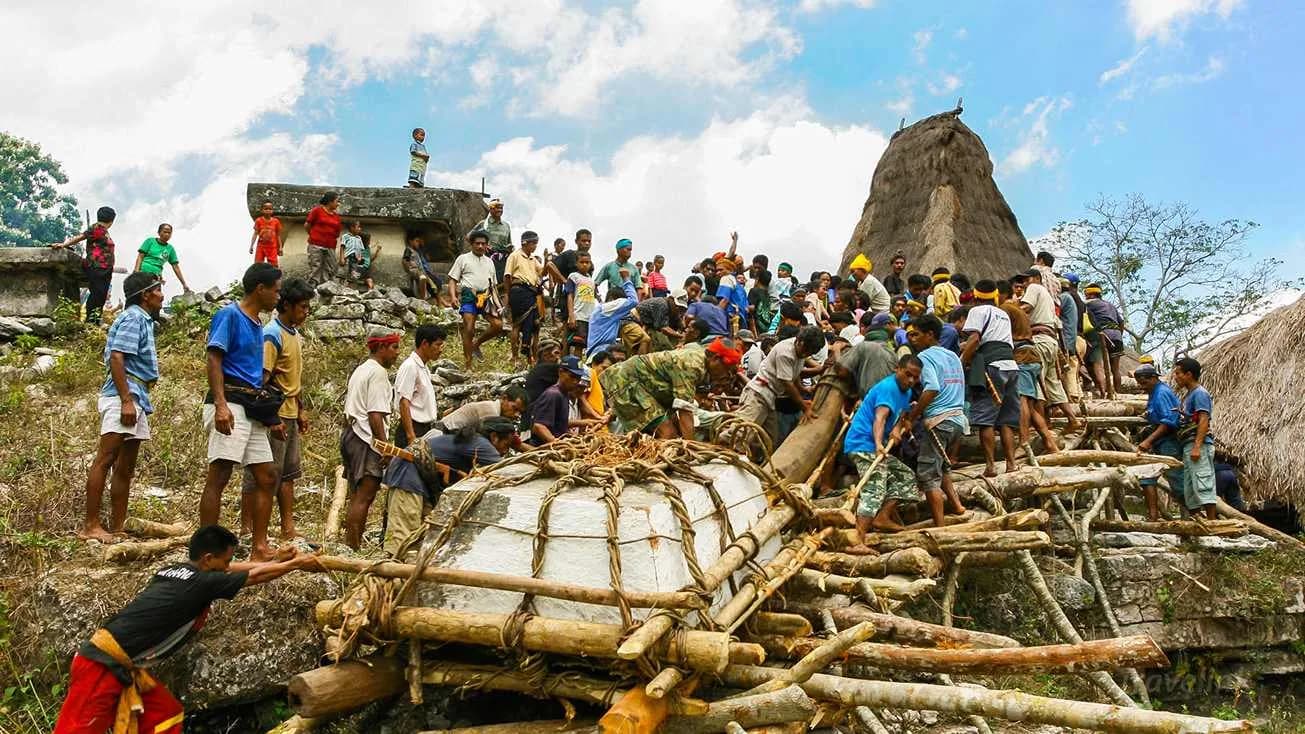
While most of us are familiar with funeral processes that take place soon after someone passes away, Sumba funeral customs follow a very different and unique path.
In Tanah Marapu, the deceased are not buried right away. They may even be kept inside the home for months, or sometimes years. For those hearing about it for the first time, this may seem unusual, even a little surprising.
What is even more remarkable is that, despite being kept for such a long time, the body does not give off a strong odor. This is because it is wrapped in dozens of layers of traditional Sumba cloth, which are believed to slow the process of decomposition.
In this article, we will explore the Sumba funeral tradition more deeply, from its process and meaning to the reasons behind this unique practice.
The Deceased Are Kept at Home, Not Buried Immediately
One of the most distinctive aspects of Sumba funeral customs is that the deceased are not buried immediately. Instead, they are kept first inside the home. For some people this may feel unfamiliar, but for the Sumba community who follow the Marapu belief, it is an important part of the tradition.
In their belief, a person who has died is not considered to have fully departed. The body is still regarded as part of the family, as someone who is "still on the journey," and so it remains in the home together with the other family members.
During this period, the body is treated with great respect, as though the person were still alive. This period of keeping the body can last for several months or even years.
Usually, the family waits for the right time to hold a large funeral ceremony that involves many people and requires careful preparation, both in terms of custom and cost.
Treated as If Still Alive
In Marapu belief, the person who has died has not truly gone but is considered to remain among the family for a while. Because of this, the family continues to interact with the body as usual.
They may talk to it, share stories, and express their feelings as if the person could still hear them.
This is not strange to them. Rather, it is an expression of closeness and affection that is still maintained. In addition, the body is also offered food symbolically. Usually the family places food or drink near the body as a sign of respect.
This is not meant to be literally eaten, but is a symbol that they continue to treat the departed as part of everyday life.
This tradition shows that in Sumba culture, death does not immediately sever relationships. Instead, there is a transitional period in which the family can still be together with the person who has passed away, before finally letting go through the traditional funeral ceremony.
No Strong Odor, Here Is the Reason
When hearing that a body is kept at home for a long time, the first thing that may come to mind is an unpleasant smell. Interestingly, in Sumba funeral tradition, the body does not give off a strong odor as one might imagine.
This is not a coincidence, but the result of a series of traditional processes carried out with great detail and meaning. Here are several reasons why the body remains preserved in this condition:
1. Wrapped in Layers of Traditional Cloth
After the body is washed, it is immediately wrapped in dozens of layers of traditional Sumba cloth. This process is carried out very neatly and thoroughly, so that almost no part of the body is left uncovered.
These layers of cloth function as a natural protective barrier that helps slow the process of decomposition. In addition, the traditional cloth also carries symbolic value as a final mark of respect from the family to the person who has passed away.
2. The Body Is Positioned in a Special Way
The body is not left in a straight position as is common elsewhere. Instead, the arms and legs are bent so that the body resembles the position of a fetus in the womb. This position is believed to symbolize the cycle of life, in which humans return to their origin.
Beyond its philosophical meaning, this position also makes the body more compact, so it can be wrapped tightly in cloth, which indirectly helps preserve the condition of the body.
3. Equipped With Traditional Adornments
The body is also given various special adornments such as the mamuli (gold ornament placed at the mouth), beads on the hands and feet called anahida, and earrings for women.
These adornments are not merely decorative but also symbols of status, respect, and provisions for the journey to the next realm. All of these items are an important part of upholding the dignity of the deceased in accordance with custom.
4. Placed on a Special Platform
After being wrapped, the body is not immediately placed in a coffin. Instead, it is seated on a small platform inside the house. This position is leaned against a house pillar, as though the deceased were still present among the family.
This placement also keeps the body in a stable and preserved position, and makes it easier for the family to continue interacting with it symbolically.
5. Stored in a Special Coffin
Once all the initial processes are complete, the body is placed in a coffin made of wood or even buffalo hide. The coffin is then leaned against a house pillar and oriented in a particular direction according to belief.
The coffin serves as an additional layer that keeps the body sealed tightly.
6. Additional Offerings and Prayers
In the later stages, additional offerings are usually made, such as the sacrifice of a horse. A priest then offers prayers to Marapu so that the entire process proceeds smoothly and the spirit receives protection.
These prayers are an important part of maintaining balance between the human world and the spiritual world.
Waiting for the Great Traditional Ceremony
In the Sumba funeral tradition, the body is usually kept while the family waits for a major traditional ceremony that requires careful preparation. About two weeks before the burial procession, the family together with relatives begins a series of preparations such as pawalla (mete).
During the ceremony, traditional sung verses accompanied by a mourning dance (renja pai) are performed by both men and women as a sign of respect and as a way of recounting the life journey of the deceased together with the ancestors.
Interestingly, the people who sing these verses are not just anyone. They are specially chosen and must begin with prayer. While performing this duty, they cannot be replaced and must sing the verses accurately.
If a mistake occurs, they are obligated to perform a ritual asking Marapu for forgiveness, because it is believed that neglecting this could bring bad consequences.
A Cultural Story Full of Values of Respect!
For the Sumba people, death is not a sudden end but a gradual process toward the next realm. For this reason, the presence of the body in the home becomes a final moment of togetherness, full of respect and affection.
This tradition may seem foreign to some people, but it is precisely here that the richness of Indonesia's culture lies.
Arranging a funeral can often be exhausting amid grief, especially when many details need to be prepared.
For this reason, Kamboja is here with a funeral service that helps ease the family's burden, including logistics for transferring the body and the other stages of the process, so that everything runs in a more orderly and peaceful way.
This service also understands that every region has different traditions, such as Batak funerals, Asmat traditional ceremonies, and Toraja funerals, which are full of cultural value and require special handling.
If you need more information about funeral services or other related services, please contact the Kamboja team at 0822-1111-1415. The Kamboja team is ready to assist you and your family with care, so that the process can proceed more peacefully during this difficult time.
- #funeral services

Kamboja Blog
The Kamboja team writes guides on bereavement, funeral arrangements and funeral planning to help families in Indonesia.