Getting to Know Batu Lemo, the Toraja Burial Site Carved into a Cliff
- dev_kamboja
- (updated )
- 5 min read
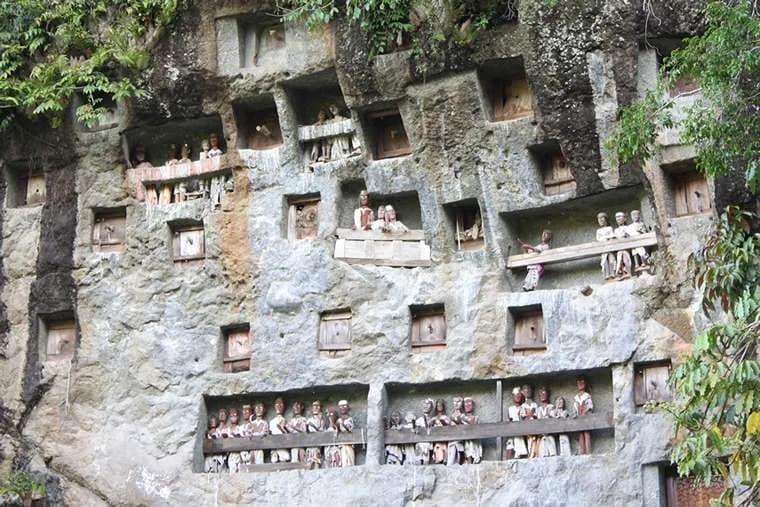
The Toraja people are well known for their unique and religious traditional burials. You can find a burial area located atop a rocky cliff. The Toraja burial system also takes many forms, including hanging graves, cave graves, ground graves, and patane.
These burial sites are rich in historical value, as they have been passed down through generations from the ancestors of the Toraja people. In addition, this distinctive way of laying the deceased to rest aims to honor a person's passing through a funeral ceremony according to local customs. Here is a fuller look at Toraja culture.
The Toraja Funeral Ceremony
The Toraja people have a traditional funeral ceremony called Rambu Solo. This ceremony serves as a final tribute to the deceased. Through Rambu Solo, the Toraja people wish to guide the spirit of a person into the spirit realm.
The Rambu Solo ceremony requires a considerable cost, as large numbers of buffalo or pigs must be sacrificed. The number of sacrificial animals is usually determined by the social status of the deceased. For example, people of mid-level nobility must slaughter 8 buffalo and 50 pigs.
Meanwhile, people of high nobility must slaughter between 24 and 100 buffalo. Therefore, it is not unusual for this ceremony to be held months or years after a person has died. In addition, there are two parts of Rambu Solo: the burial procession, known as rante, and art performances.
The burial procession, or rante, takes place in an open field in the middle of the traditional Tongkonan house. The funeral then concludes with the procession carrying the body from the Tongkonan house to the burial complex. The Toraja people also believe that the higher the grave is located, the faster the soul will reach heaven.
The Origins of Batu Lemo in Toraja Burial
This ancient burial site of the Toraja ancestors is made of carved stone and is named Batu Lemo. The graves are set into the wall of a tall hillside cliff and feature many holes and statues. There are at least 75 holes in the cliff wall. Some of these holes are also fitted with rows of statues.
The name Batu Lemo itself comes from a large, orange-shaped rock located inside one of the caves. The first grave in the Lemo area is in the top left cave on the northern side. Dozens more stone caves are spread from north to south.
Each burial hole measures roughly 3 x 5 meters. One hole at Batu Lemo is usually used for the burial of one family. The front of the hole is where the body is placed. The cover of the hole may be carved wood or simply a bamboo covering.
In several places within the Batu Lemo area, coffins are stacked or arranged in an orderly way. The arrangement of these coffins is usually based on the family lineage.
The Tongkonan Traditional House
The traditional Tongkonan house stands beside the ancient Batu Lemo burial site. The central courtyard of the Tongkonan house is usually used by the community to hold traditional funeral ceremonies.
The word Tongkonan comes from Tongkon, meaning to sit together. A Tongkonan consists of 3 buildings and 3 granaries. This Toraja traditional house has a distinctive roof structure made of bamboo and wood, curved like a boat.
At the front of the Tongkonan house are buffalo horns. Inside, there are a bed and a kitchen. The granary stands directly in front of the Tongkonan house. The Tongkonan house serves as a symbol within the Tallung Penanian, which consists of Para in Lemo, Arung in Torre, and Pong Letten in Limbu.
The Meaning of the Statues at Lemo Toraja
The statues found on the outside of the cliff burial holes in Toraja actually carry special meaning. These statues, called Tau-Tau, represent a person's rank or social status and role during their lifetime as a Toraja noble. Tau-Tau statues are also keepsakes for the family.
Even so, not everyone chooses to have a statue made at the burial site. This is because the family must first hold a Rambu Solo ceremony and sacrifice 24 buffalo in order to obtain a statue. The price of a single buffalo can reach tens to hundreds of millions of rupiah.
The Tau-Tau statues have quite a deep philosophical meaning. They are carved with the right hand facing upward and the left hand facing downward. The upward hand signifies asking for help to reach heaven, while the downward hand signifies blessing the lives of the descendants.
Funeral Services
Aside from the traditional customs of a Toraja funeral described above, the funeral process can be quite draining. You can make use of a complete body care service to make the process easier and faster. Kamboja offers an on demand service for comprehensive funeral arrangements, as well as professional funeral insurance services.
Kamboja's on demand service covers body care, transportation, headstones and coffins, all the way to cemetery arrangements. Its service packages include Muslim funeral packages, Christian funeral packages, and cremation packages. In addition, there are death certificate arrangement services, flower arrangements, tents and chairs, and catering.
You can contact Kamboja's Funeral Manager via WhatsApp to book the best on demand funeral service. Kamboja's service team is able to provide the best service tailored to your needs within 3 hours of receiving a client's request.
Already Familiar with the History of Toraja Burials?
In short, Rambu Solo is a traditional ceremony for Toraja funerals held within the Tongkonan house complex. The burial of the deceased takes place at Batu Lemo, which sits atop a tall cliff. These graves are also decorated with rows of Tau-Tau statues, symbolizing the social status of the person who has passed away.

dev_kamboja
The Kamboja team writes guides on bereavement, funeral arrangements and funeral planning to help families in Indonesia.


