Indonesia is home to many unique cultures full of meaning, one of which is the Asmat traditional ceremony from Papua. This tradition is not merely an ordinary funeral procession, but also a deep form of final respect for the person who has passed away.
In Asmat culture, death is not the end but part of a journey to the world of spirits, which remains connected to human life. Through this article, we will discuss in full how the funeral traditions of the Asmat people are carried out, so you can better understand the remarkable cultural richness of Indonesia.
Procedures for Handling the Deceased
In Asmat traditional ceremonies, the handling of the deceased is carried out in a very distinctive way, rich in spiritual meaning. Unlike common customs, the Asmat people have their own way of treating the body as a final form of respect for the person who has passed away.
Typically, the body is placed on a para, a kind of woven bamboo platform prepared in an area outside the village. There, the body is left to undergo natural decomposition.
Although it may sound unusual, for the Asmat people this is an important part of the cycle of life and a way of returning the human body to nature.
Once this process is complete, the remaining bones are gathered with great care. These bones are then kept in a special place, usually on wooden posts as a symbol of respect. One of the most sacred parts is the skull. The skull is not discarded but is kept and even used as a pillow by close family members.
This is not without reason; it is a symbol of love and closeness that remains preserved even though the beloved is no longer present. The Asmat people also believe that the spirit of the deceased, known as bi, still lingers around the village.
For this reason, they often give form to the deceased in the shape of a wooden statue called a mbis statue. These statues can stand about 5 to 8 meters tall and serve as a symbol of the spirit's presence and of respect for ancestors. The existence of these statues also serves as a reminder that the bond between the living and the departed is never truly broken.
Escorting the Deceased
Within the sequence of Asmat traditional ceremonies, the escorting of the deceased is also a moment full of emotion and meaning. This tradition is not only about accompanying a departure, but also a way for the community to express deep grief.
One rather unique and moving custom is that some villagers roll along the path that the funeral procession will take. This is usually done by family or close relatives who feel the loss, as an outpouring of overwhelming sorrow.
Indeed, it is not unusual for them to roll their bodies in the mud while continuing to follow the procession. Though it may seem extreme, for the Asmat people this is a genuine expression of love and loss for the one who has gone.
They express their grief openly, letting emotions flow naturally as part of the mourning process. Throughout the journey, the atmosphere is usually filled with weeping and lamentation.
The villagers walk together while mourning the departure of a family member, creating a deeply moving atmosphere full of togetherness. This tradition also shows the strength of social bonds within the Asmat community, where grief is felt not only by the immediate family but by the entire community.
The Asmat Funeral Process
In Asmat traditional ceremonies, the funeral process is not a single form but consists of various unique traditions full of meaning. Each ritual has its own purpose, from honoring the deceased to maintaining the connection with ancestors. Let's discuss them one by one:
1. Mummification Tradition
One of the most fascinating traditions in Asmat ceremonies is mummification, that is, preserving the body of a deceased person. But not everyone is treated this way.
Typically, only traditional leaders or important figures have their bodies preserved. This process is carried out as the highest form of respect because they are considered to have made great contributions to the community.
Once preserved, the mummy is displayed in front of the traditional house. The purpose is not merely as decoration, but as a symbol that the person remains "present" and honored by the community.
2. Mbismbu Ceremony
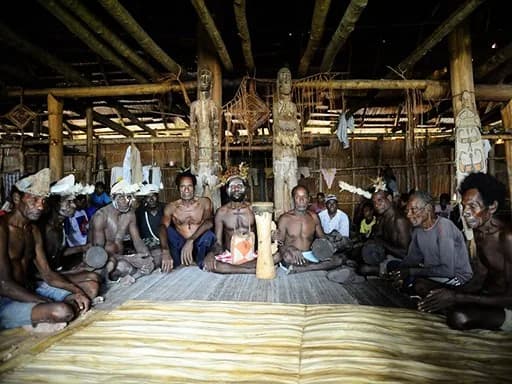
Next is the Mbismbu ceremony, which involves the making of wooden statues as representations of ancestors or family members who have passed away. These statues are often called mbis statues, and they are tall and richly carved in the distinctive Asmat style.
This ceremony is very meaningful because it is a way for the community to continually remember and honor their ancestors.
Interestingly, in older beliefs, if someone died by murder, the family or group felt it necessary to take revenge as a form of justice. This shows how strongly the value of honor runs through their culture.
3. Tysimbu Ceremony
There is also the Tysimbu ceremony, a tradition held roughly once every five years. In this ceremony, the community builds and consecrates a lesung house or long canoe that carries symbolic meaning.
The canoe is decorated with alternating white and red colors, then adorned with various carvings such as images of deceased family members, animals, or other symbols. The canoe is also decorated with sago as part of their cultural identity.
Before the ceremony begins, the extended family gathers at the chief's house to hold performances such as songs and dances accompanied by the traditional tifa drum. The atmosphere is warm, full of togetherness, and at the same time sacred.
4. Yentpokmbu Ceremony
Finally, there is the Yentpokmbu ceremony, which relates to the naming of the bachelors' house. The bachelors' house is an important building in Asmat community life, as it is used for various activities, both religious and social.
Typically, the house is named after the clan of its owner as a sign of family identity. In addition, the bachelors' house also serves as a gathering place for family members and the community.
Interestingly, in certain situations such as when threatened or attacked, the house follows special rules, for example, women and children are not permitted to enter.
Every Tradition Holds Stories, Values, and Wisdom
Through the Asmat traditional ceremony, we can learn that every culture has its own unique way of understanding life and death. This tradition is not only about farewell, but also about love, respect, and hope.
Beyond the Asmat traditional ceremony, there are also special-needs traditions such as Toraja funerals, where every detail of the procession can be adapted to the customs and traditions that apply.
When facing loss, what matters most for the family is having time and space to grieve calmly, without being burdened by technical matters that can be quite complex.
Kamboja offers funeral services and body care services designed to help the whole process run smoothly, orderly, and with full respect.
With the support of a professional team, every logistical need through to the execution of the event will be handled thoroughly, so the family does not have to struggle to manage it on their own. If you need help or would like to consult us, you can contact us directly on WhatsApp at +6282211111415.
- #funeral services
- #jasa kedukaan
- #manajemen pemakaman

Kamboja Blog
The Kamboja team writes guides on bereavement, funeral arrangements and funeral planning to help families in Indonesia.