What comes to mind when you picture a funeral tradition? Usually, funerals are associated with moments that are deeply moving, sorrowful, and filled with tears. However, not every society in the world experiences funeral rites with that kind of atmosphere, including the funeral ceremonies of Toraja.
One of them is the Toraja people of South Sulawesi, who carry out funeral traditions as a final mark of respect for someone who has passed away.
This tradition is known as Rambu Solo or Aluk Rambu Solo. In Toraja, "aluk" refers to customary values, beliefs, and traditional rituals that have been set down by ancestors and are carried out strictly.
So, what does the Rambu Solo funeral tradition look like in Toraja? Without having to travel there in person, let's first take a look at the overview below.
The Meaning and Significance of the Rambu Solo Ceremony
As mentioned earlier, Rambu Solo is a customary funeral ceremony carried out by the Toraja people.
The practice of this tradition is a form or symbol of final respect for someone who has passed away.
For the Toraja people, death is not the end of a person's journey, but a transition from this world to the spirit realm where they can rest. This realm is called Puya.
And as part of the journey to reach that destination, the deceased must be treated well by the family they have left behind.
Unlike most traditions, Toraja tradition considers a person to be truly deceased only once all the stages of the Rambu Solo ceremony have been completed.
Until then, the deceased is treated like a sick person, which means they must still be offered food and drink, and laid down on a bed.
So, how long does the Rambu Solo ceremony last? The entire series of Rambu Solo rites takes a long time. As an important ritual, it is not uncommon for the ceremony to be held for months or even years after a person has passed away. That is also why this customary ceremony can take a considerable amount of time.
Aside from the duration, the high cost of Rambu Solo is also due to the slaughtering of animals such as buffalo and pigs. The slaughtered animals are served as food and shared with the surrounding community, since Rambu Solo is organized like a grand celebration, given that it is a final mark of respect for the deceased.
Another interesting aspect of Rambu Solo is that all remaining assets of the deceased are buried together with them. According to Detik, community leader Layuk Saroenggalo explained that this is done so that children do not depend on inheritance, and so that wealth is returned to the community in a social form.
Social Strata in the Rambu Solo Ceremony, funeral ceremonies of Toraja
The Rambu Solo ceremony is also held according to the strata, status, or social rank of the deceased. As such, how a family of higher social status carries out Rambu Solo differs from that of a family of lower status. These differences are meant to show the social status group.
A. Dissili' Ceremony.
This ritual is the funeral ceremony for people of the lowest social strata, or for children who have not yet grown teeth and have passed away. Furthermore, the Dissili' ceremony is divided into 4 (four) forms.
B. Dipasangbongi Ceremony.
For people belonging to the common folk stratum, the ceremony performed is called the Dipasangbongi ceremony. This ritual also consists of 4 (four) forms, each of which differs, with sacrifices ranging from 4 pigs to 2 buffalo.
C. Dibatang (Digoya Tedong) Ceremony.
Then there is the Dibatang or Digoya Tedong ceremony, held when the deceased belongs to the middle nobility. The Dibatang ceremony consists of 3 (three) types, each held over 3, 5, and 7 days, while the number of pigs and buffalo sacrificed also varies, from 3 to 7 animals.
D. Rapasan Ceremony.
And for the high nobility, the ritual performed is called the Rapasan ceremony and is held twice within a year. The first ceremony is called Aluk Pia, and the second is called Aluk Rante. Furthermore, the Rapasan ceremony is divided into 3 (three) types, with far more pigs and buffalo to be slaughtered, ranging from 9 to more than 100 animals.
Procedures of the Rambu Solo Ceremony, funeral ceremonies of Toraja
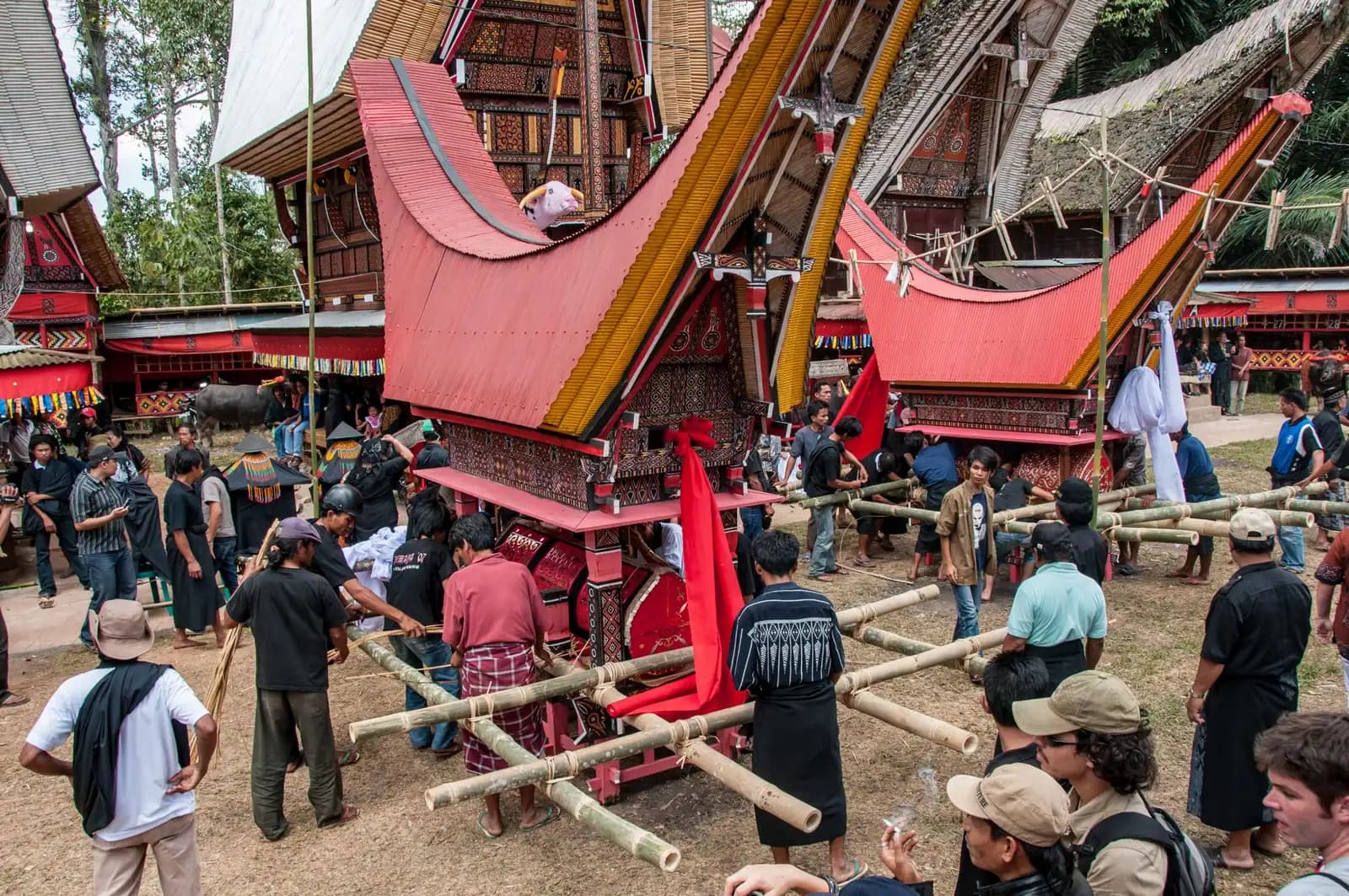
So, what are the procedures of the Rambu Solo ceremony? The process itself is divided into 2 (two) main parts: the funeral (rante) and artistic performances. Both are held together in one and the same funeral ceremony, which can last from 3 to 7 days.
The Rante procession takes place on the open ground in the center of the Tongkonan traditional house complex and consists of several stages:
- First is Ma'Tudan Mebalun, the process of wrapping the body in a burial cloth by To Mebalun or To Ma'kayo.
- Second is Ma'Roto, the process of decorating the coffin with silver and gold thread.
- Third is Ma'Popengkalo Alang, the process of lowering the body into the granary as its resting place.
- Last is Ma'Palao or Ma'Pasonglo, the escort of the body from the Tongkonan house to Lakkian, the burial complex.
Although it appears festive, especially because of the artistic performances that are part of Rambu Solo, this procession is not merely meant to liven up the ceremony. The artistic performances are also an expression of respect and a prayer for the one who has passed away.
Some examples of artistic performances commonly held during Rambu Solo include Ma'pasillaga Tedong, or buffalo fighting, Ma'tinggoro Tedong, or buffalo slaughtering, as well as music and traditional dance performances of the Toraja people.
Through these artistic performances, the Toraja people also show the values of mutual cooperation, helping one another, and togetherness.
What Happens If Rambu Solo Is Not Carried Out?
As a customary law, it can be concluded that carrying out Rambu Solo is an obligation for the Toraja people. In addition, there is a belief that if Rambu Solo is not held, misfortune will befall those who are left behind.
That is why the Toraja people continue to carry out Rambu Solo to this day, even as the world has become much more modern. Beyond that, the performance of the Rambu Solo customary ceremony is also a way for the Toraja people to continue preserving the values and customs passed down through generations from their ancestors.
Rambu Solo can also serve as an example of how expensive funeral costs have become today, even though the process itself does not take days. Especially in big cities today, where funeral costs can reach millions.
Since death is certain, there is certainly no harm in planning for funeral costs starting now, right? Moreover, there is now Kamboja funeral insurance that can provide protection for you and your family. Besides helping with funeral costs, this insurance can also relieve the financial burden on the family left behind during their time of grief.

dev_kamboja
The Kamboja team writes guides on bereavement, funeral arrangements and funeral planning to help families in Indonesia.