People from outside the Minahasa region may assume that waruga are simply old graves. However, for the indigenous community, these uniquely shaped stone tombs hold historical value related to the struggles of their ancestors, serve as a mark of family identity, and are a symbol of past culture.
To learn more about waruga, read the explanation below to the end.
What Is a Waruga?
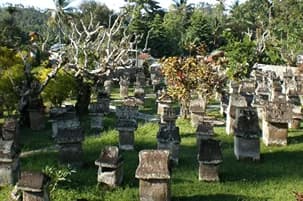
Waruga is a distinctive grave or tomb made of stone and shaped like a house. It is also a tradition in which the deceased is placed inside a hollow stone chamber, which is then covered with a triangular prism-shaped stone.
These tombs can be found in the Minahasa region of North Sulawesi province. The original function of waruga was as a burial place and a medium for animistic or dynamistic beliefs. Today, however, these distinctive Minahasan tombs have become sites for educational and cultural tourism.
When the community placed the body inside a waruga, the deceased was positioned like a baby in the womb.
This is because the Minahasan people believe that human life begins with the position of a baby in the womb and must end in that same position. This philosophy is commonly called "whom" in the Minahasan language.
History
Waruga is an ancient burial system from the megalithic era (the age of great stones), which took place around 1500 BC. Archaeological research indicates that these tombs have existed since the 4th century BC. Later, the Minahasa community began to abandon burial ceremonies of this kind around the early 20th century AD.
In earlier times, the Minahasan people prepared the deceased by wrapping them in woka, a type of palm leaf.
Over time, the Minahasan people began using waruga, with the body laid facing north. This was because they believed their ancestors came from the north.
This burial was also a form of communal grave. That is, a stone tomb could hold more than one person. In the past, in Minahasa, waruga burial sites were located in yards or around residents' homes. In each home, you could find about 1 tomb or more.
Unfortunately, during the colonial period, specifically in 1860, the Dutch banned this tradition. At that time, typhus, cholera, and plague were spreading. The Dutch believed these diseases could spread through the gaps in these stone tombs.
In addition, the arrival of Christianity at that time, which required bodies to be buried underground, also influenced the burial traditions of the Minahasan people.
Meaning and Origin of the Name
There are several versions of the meaning and origin of the word for these stone tombs. Waruga comes from two words in the Tombululanguage, namely wale and ruga. Wale means house, while ruga means destroyed. This is because the distinctive shape of the Minahasan tomb resembles a cremation site, which was usually where bodies were destroyed.
According to Santoso Soegondho, waruga comes from the word moruga, or boiled. This is because after burial, the body placed inside swells like boiled meat.
According to Deni Pinontoan, waruga comes from the word wawa (wa), meaning 'completely', and ruga meaning 'worn-out clothing'. From these two words, it is concluded that waruga is a place where the body dissolves.
Another version states that the word waruga comes from the word wale (house) and roga (spirit), meaning the place where spirits reside. This relates to the belief of the Minahasa people Minahasa in ancestral spirits who often help the living.
Characteristics of Waruga
This distinctive Minahasa tomb is made from a sedimentary stone called tufa or basalt lava. This igneous rock is also known in the local language as tras or domato . The stone becomes harder, stronger, and more durable when exposed to open air. It originates from the eruptions of Mount Klabat and Mount Lokon.
A waruga consists of two parts, the upper and lower sections. The upper part is shaped like a rectangular prism resembling a roof ridge. The lower part is box-shaped. The inside of the box is hollow or contains a chamber that serves as the resting place for the deceased.
Waruga come in various sizes. The smallest is about 50 cm x 50 cm x 100 cm, and a medium size is about 100 cm x 100 cm x 150 cm. The largest is about 150 cm x 100 cm x 145 cm.
Waruga Ornaments
On the roof ridge of this stone tomb are carvings or ornaments that serve as markers of the family and the occupation of the deceased. These ornaments come in many motifs, such as standing people, people sitting without clothing, and a woman giving birth. There are also plant motifs such as flowers and leaves.
You can also find animal motifs such as chickens, snakes, and imaginary animals like dragons. Some feature traditional geometric motifs such as clouds, mursal, and double spirals.
For example, if a person worked as a traditional midwife during their life, the motif on the upper part of the waruga will be a woman giving birth. Or if the roof ridge bears an animal motif, the deceased was a hunter.
Besides serving as markers and for aesthetic purposes, these ornaments represent the beliefs of the Minahasa people about life after death. For this reason, the Minahasa people regard these ornamental motifs as sacred.
Do You Know What a Waruga Is?
A burial place This distinctive stone structure is highly valued by the Minahasa people because it is evidence of the journey of their ancestors. It serves as a temporary resting place for the souls of Minahasa ancestors, which is why the waruga are still well preserved.
In addition, people living today should pay attention to burial protection, because funeral costs are rising in this era. For this reason, you can use burial protection services from Kamboja.
That way, you need not worry about funeral costs and arrangements because Kamboja has arranged everything. For more information, please visit the website Kamboja.

dev_kamboja
The Kamboja team writes guides on bereavement, funeral arrangements and funeral planning to help families in Indonesia.